
Scholarship student explores the downside of the Bali dream
While many people dream about an idyllic holiday in Bali, the province is struggling with the environmental challenges that tourism brings. In 2025, the Indonesian Embassy awarded the Nusantara Scholarship to Master’s student Annabel Burgess, who lived in Bali for six months to explore sustainable tourism ventures.
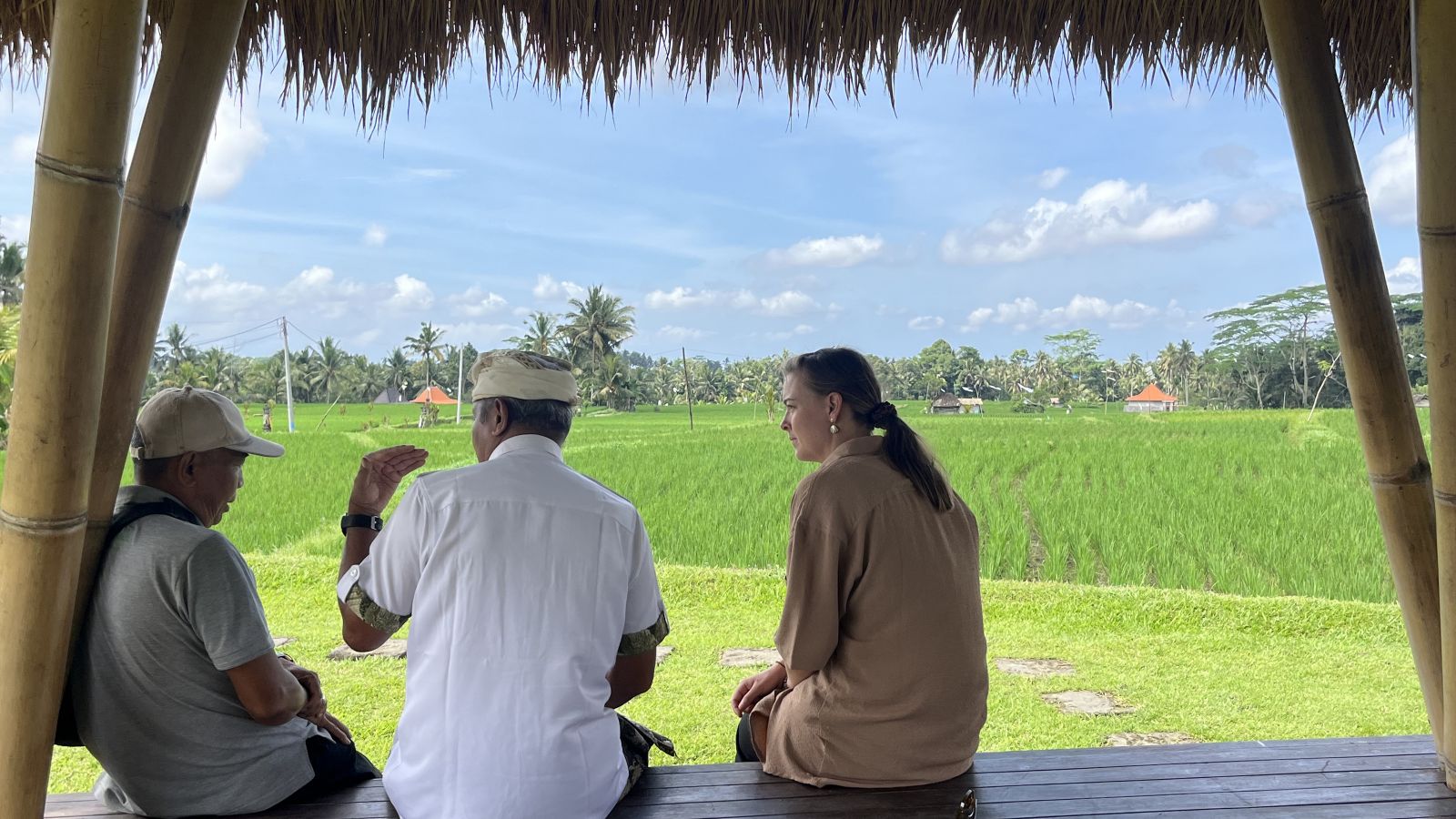
In New Zealand, Annabel had previously worked as a lawyer and founded her own company, Third Era Sustainability Consulting, but she had always nursed an interest in Development Studies. For her Master’s research, she wanted to combine her business experience with a focus on sustainability—and Bali provided the ideal location.
Annabel wanted to go behind the scenes to see how businesses there are effectively counteracting their environmental challenges and how that might inform change both in Indonesia and around the world. “Bali has such a diverse population with so many pressures—if Bali can solve it, anywhere can,” says Annabel.
Those pressures became obvious to Annabel within a few months of arriving in Bali. Unprecedented rainfall caused flooding, landslides, and tragic loss of life. The island’s landfill was at absolute capacity, and land disputes caused by rapid tourist development led to provincial protests over inequality and corruption.
“Immersing this deeply in Bali was emotionally confronting,” says Annabel. “I found myself struggling with the contrasts: a place overflowing with generosity, spirituality, and cultural wisdom, yet burdened by unsustainable growth and a tourist social media obsession that turns places and communities into Instagram backgrounds.
“Driving past Suwung landfill to Bali State Polytechnic’s campus weekly, I could feel, see, and smell the weight of Bali’s environmental reality. Yet at the same time, I visited inspiring businesses whose leaders were actively shifting the narrative.”
From reviewing the literature, Annabel had expected sustainability practices in Bali to be driven either by Western frameworks, such as the Sustainable Development Goals, or by Balinese Hindu philosophies like Tre Hita Karana which emphasise harmony between people, nature, and the divine.
However, when she spoke to people on the ground, she found that the leading sustainable businesses, whether village offerings and hostels, or multinational resorts, were not motivated by these external factors.
“Instead, I found that the core driver of change and the defining factor of best practice sustainability was internal moral ambition: a leader’s sense of ethical responsibility and their commitment to delivering this in practice.”
Annabel found that these leaders had an innate sense that their tourist businesses had contributed to Bali’s problems and wanted to solve them, especially in rural areas where they could see suffering in surrounding communities. They expressed these concepts in heartfelt ways, telling Annabel, “when the environment is hurting, we are hurting.”
“The businesses I found paving the way in sustainability are some of some of the best examples I have seen in corporate sustainability practices globally,” says Annabel.
She observed gardens that used sophisticated underwater filtration systems and permaculture and a culture of using repurposed materials. People were persistent in seeking acceptable solutions through trial and error—for instance to find a fabric softener for towels that satisfied tourists but didn’t use chemicals.
Professor of Human Geography and Development Studies, Sara Kindon, says, “I’m delighted that Annabel’s experience met the aims of the Nusantara Scholarship—to promote greater academic cooperation and people-to-people connection between Indonesia and New Zealand.
“It was great to connect Annabel with Dr Putu Hermawati at the Bali State Polytechnic. I first worked with Putu during my own Master’s research in 1991-93 as part of the Canadian government’s Bali Sustainable Development Project. Putu provided an academic home for Annabel, then Annabel made the most of the opportunities of the Nusantara Scholarship for her learning.”
In future, Annabel hopes to apply her learnings to sustainability practices in the New Zealand tourism industry, investigating further what motivates people to take the difficult step from knowledge to action.
“The Nusantara Scholarship allowed me to meet and engage effectively with a wide range of people allowing for deeper contextual understanding,” says Annabel. “Taking language lessons and being able to live in the country added significant value to both my research outcomes and my personal growth.”
The Indonesian Embassy states:
“We were delighted to work with the University in awarding the Nusantara Scholarship to Annabel. The scholarship aimed to build understanding and a good relationship between Indonesia and New Zealand through academia, taking its name ‘Nusantara’ from the ancient Sanskrit name bestowed on the archipelago that we know today as Indonesia.
“Our goal with this scholarship was to ensure that the recipient gains a deeper appreciation of Indonesia from Sabang (the westernmost point of the country) to Merauke (the easternmost city in Papua), as well as a chance to further their academic career.
“We are pleased to see that Annabel has not only done that but has also highlighted the important issue of sustainable tourism in Indonesia’s most well-known island of Bali. Undeniably, the tourism boom has changed Bali, its people, and practices over the years. The government of Indonesia continues to strive for improvement, and we are certain that Annabel’s research is a valuable contribution to ensure its continued sustainability and prosperity."
Annabel’s study was also supported by a Graduate Women Wellington Master’s by Thesis Scholarship and an Asia New Zealand Foundation Research Grant.