
The integration of AI in organisations to improve productivity, wellbeing, and work-life balance
Talitakuum Ekandjo remembers first meeting technology in her senior year of high school in Namibia. Growing up in rural Namibia, there was often no electricity. One of her teachers told her about the computer lab and suggested applying to universities. “The teacher assumed we were all computer savvy.”
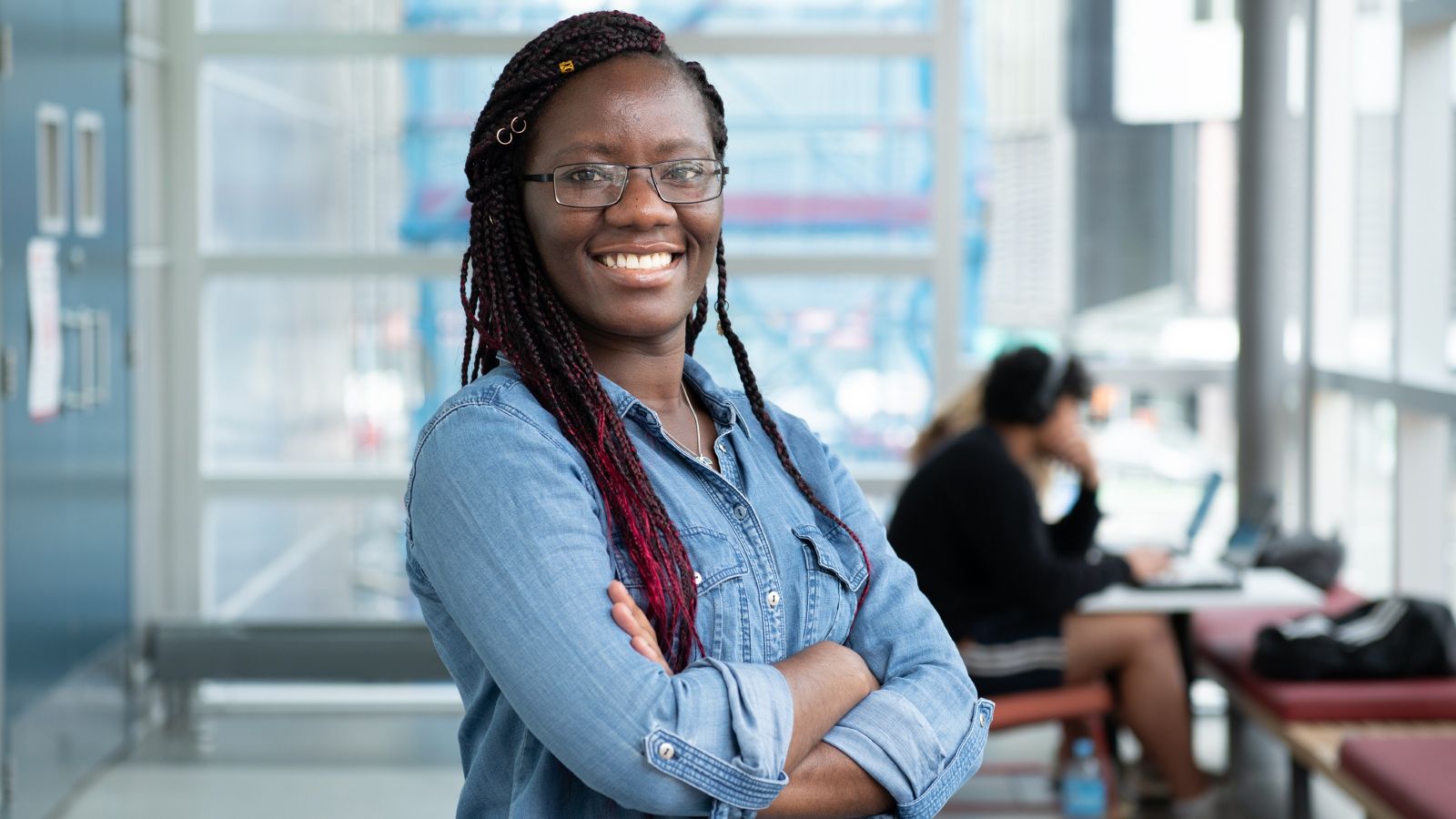
Talitakuum, now a third-year PhD student in Information Systems at the School of Information Management, Te Herenga Waka―Victoria University of Wellington, remembers the heart-breaking moment she realised she would be unable to apply to university because she had no idea how to use a computer.
That “watershed moment” has taken Talitakuum through undergraduate studies and industry work in various IT roles before beginning her PhD. She earned a diploma in information systems administration and an honours degree in business administration in Namibia, and a Master of Information Systems at the University of Melbourne.
“I became interested in gaining a deeper understanding of how we can best use emerging information systems to support organisations and ensure they get the most out of their investments. I wanted to come to New Zealand to do my PhD, and I don’t regret that decision a bit.” She hopes to stay here upon completion of her studies in 2023.
She is now studying artificial intelligence (AI) in organisations, specifically how people integrate and work with intelligent personal assistants (IPAs) in their daily work lives.
The working title for this research is ‘Impacts of enterprise intelligent personal assistants on work-life practices’.
“The goal of my study is to provide insights into the opportunities, concerns, and challenges faced by employees who collaborate with AI. I hope also to provide insights into what can be done to improve the experiences and maximise the benefits of the use of these tools.”
In 2020 and 2021 she had her work shared at conferences including the Australian Conference on Information Systems (ACIS), Pacific Asia Conference on Information Systems (PACIS), European Conference on Information Systems (ICIS) and was selected for the International Conference on Information Systems (ICIS) as one of the top 40 students.
She has also had the opportunity to present her work to industry professionals at the ITP NZ 2021 ITx Innovation Day in Wellington, and to Datacom Women in IT. Encouragement and feedback and overall interest in the research has been “tremendous”.
These experiences all strengthened the conviction that she could complete the PhD programme. Talitakuum adds, “I realised the more I talked about my research, the more confident I became, and the constructive feedback helped me refine my ideas”.
She also praises her supervisors, Dr Jocelyn Cranefield (primary) and Dr Yi-Te Chiu (secondary) for making the journey easier. She is confident that the research will have commercial impacts.
One observation from the research is that many employees struggle to manage their daily tasks, which has a negative impact on their productivity, wellbeing, and work-life balance.
Talitakuum says, “the AI tools I’m investigating are intended to assist employees in developing better and healthier work practices and habits. The study’s findings can help in the use and planning of AI tools, and how to understand effective use of them as well as any arising issues that must be addressed.
“AI and analytics systems are increasingly being used in organisations, particularly to support the management of personal productivity and wellbeing. These are major concerns for many organisations, so much so that Gartner’s 2020 Hype Cycle for the digital workplace identified employee productivity monitoring and wellness as trending issues for digital organisations in the coming years.”
She has found her PhD journey has been comprised of highs and lows, being both confidence-boosting and confidence-draining. Talitakuum calls it “humbling,” saying that the most difficult challenge of all is the inherent imposter syndrome. She says learning to accept that as part of the journey is crucial.
The COVID-19 lockdowns and the protests that emerged as a result of them were huge challenges. Talitakuum says, “isolation, neglecting self-care, and self-doubt, and the toll of all of that on my mental health were the three things that stood out”. She arrived in New Zealand in early 2020 and immediately began her studies. She says being constantly buried in her work was less than ideal, and at first the guilt she felt from taking a break only added to her anxiety.
Through a support network that includes friends, family and the university―“amazing in terms of providing research assistance and services even during difficult times”― Talitakuum has not only learned to embrace taking a break, she has built socialising, language learning, volunteering and exercise into her routine.
“This has been extremely beneficial in ameliorating my feelings of isolation and self-doubt.”