
Trina Elkington-Ball (Writing for the Page, 2025)
Those naïve fantasies I had about the life of a writer are surpassed entirely by the seductive, demanding and complex reality. I am changed.
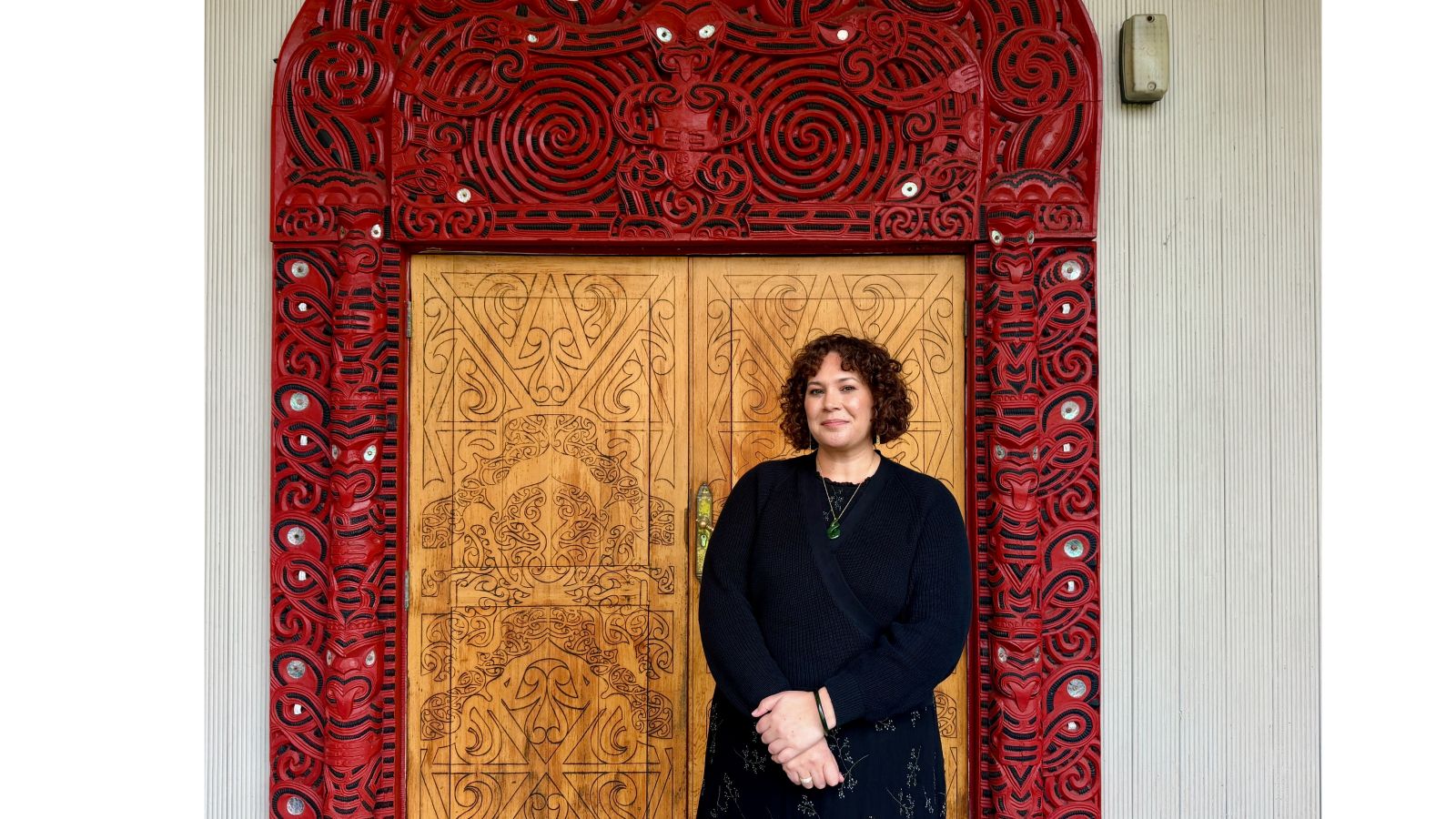
Trina writes: 'I become aware of the International Institute of Modern Letters while working as a bookseller. Inside the iconic, independent The Women's Bookshop on Ponsonby Road, my boss tells me, "It's the best writing programme in the country." Part of my job is "receiving": the process where I unpack, scan, sticker and shelve the books. While leafing through newly arrived titles, scanning blurbs and author profiles, I notice how common it is for the IIML to appear in bios of Aotearoa's writers. At that time, amongst our most popular titles are Greta and Valdin by Rebecca K Riley and Kurangaituku by Whiti Hereaka: both had studied at the IIML, graduating with an MA in Creative Writing, and both went on to win national literary prizes at the Ockham Awards. And then that thing happened, where something you'd never heard of starts cropping up everywhere: in conversations, in Instagram stories, in magazine articles, and you wonder how it's possible you've only just learned about this thing. I hear from my younger cousin, a talented singer/songwriter: she's doing this exact Master's programme. It's intense, she says, but she's loving it—for her it's the realisation of a childhood dream.
'Out of curiosity I look the IIML up online, like some schoolgirl with a crush, just to see what all the fuss is about. I read through the course description, essays of graduates and the detailed application criteria. I think how incredible it would be to dedicate an entire year to the craft of writing. I indulge in the fantasy; envision myself in Jo March style scribbling furiously with ink and parchment, or at a typewriter tapping out brilliant lines with precision. Aren't these tableaus the life of a writer? I succumb to responsible practicality and tuck these scenes away with my other unrealised dreams—and then my life changes trajectory…again.
'For two years I’d navigated the smouldering ruins of my past life. The departure from a once-cherished church community that turned out to be a problematic, high-demand religion/cult, and the slow death of a twenty-five-year marriage. A backdraft of financial instability roars up and consequentially my three kids and I move from Tāmaki to Whanganui-a-Tara. We find safety in a family home and living on our Ngāti Toa whenua. I support my kids through all the changes; new house, new schools, new friends. I ask myself: what will my new life look like? The IIML comes immediately to mind and lodges there. I list the pros and longer cons, till the words "Why not you? You'll never know if you don't try," convince me.
'Now I have a deadline. I pull out the bits of writing I've attempted over the last year and start to write essays with purpose. I submit my application in secret. I must safeguard myself from the embarrassment of telling people that I was rejected. This strategy backfired because then I had no one waiting on my call, ready to celebrate when I got the acceptance email.
Lesson #1: Share the process with your people in real time.
'I get an email from The Dr Tina Makereti who is to be my MA convener and supervisor. Despite my conscious effort to tone it down, I emit major fangirl energy that doesn’t wear off. In fact, my admiration and respect for Tina only increases as the year goes on. Before we even meet, she takes time to share with me that she was a solo māmā of two herself when she completed the Master's programme. Her manaakitanga is top tier.
Lesson #2: There are people who have forged the way ahead, listen and trust the proven process.
'Included in the email is an introduction to my workshop cohort. Reading these bios is a nausea-inducing exercise. Here is a group of undeniably intelligent, creative people who have already won literary prizes, are already published, and most of them are young, younger than me anyway. It's been two decades since I was a university student. This sends me into a panic of imposter syndrome. Who the hell do I think I am? This is a mid-life crisis/perimenopausal delusion of a recovering tradwife. I try not to think, there must've been a shallow application pool this intake. And yet…I have been accepted too. It's true that I don't have the same level of writing expertise, but I do have interesting life experience, a hunger to learn and something to say.
Lesson #3: To fully commit includes backing yourself. Tall poppy syndrome and kūmara sweetness be damned.
'In typical Wellingtonian fashion, the IIML / Bill Manhire House is perched on the side of a steep hill. I sit and take a selfie at Janet Frame's writing desk. Walk by the portraits of past writers in residence, the famous faces of Patricia Grace, Fiona Kidman, Witi Ihimaera, Michael King. The kitchen reminds me of my Nan's house, down to the silver latches on the painted cupboards. The double glass doors to the workshop room open to a magnificent view of the harbour. I marvel at the long list of acclaimed authors who've sat in this room; Tusiata Avia, Hinemoana Baker, Nafanua Purcell Kersel, Eleanor Catton, Catherine Chidgey. The air hums with this legacy and with the unseen words and ideas of the newly initiated.
'The seats we take on the first day we more or less inhabit the entire year. Each workshop begins and ends with karakia. Our three-hour workshop breaks in the middle for shared kai. We take turns bringing baked goods to eat with our coffee, trays of two giant coffee presses and eleven smoke-tinted Arcoroc mugs, a jug of milk. There is no sugar and I'm not going to be the muppet who asks, so I try coffee without sugar and discover that I like the sharp, cleaner taste—it feels bad-ass. I go outside on the back stairs and hang out with the vapers, we chat, stretch and breathe under the trees. An after-workshop lunch at the postgrad café Milk and Honey organically becomes standard. These rituals become an important container to hold the searing, vulnerable work that happens inside the workshop.
'Our cohort is a first for the IIML. Nine of the ten students are Māori, Pasifika or Tauiwi of Colour. Our one Pākehā jokingly refers to themself as the token representative. The LGBTQ community has strong representation that is wildly celebrated. We are lucky to be set up in this unique environment, grouped with others who have lived experience along the spectrum of marginalisation and the impacts of colonisation. This translates into a sensitivity and appreciation of the cultural and political layers in each other's work. Led by Tina, we create a true whakaruruhau to hold us as we repeatedly bare our souls to each other.
'I fall in love with each member of my workshop. To most people it sounds horrific to sit in a room bound to silence while ten other writers discuss your work for an hour or three. What an absolute privilege it is to read their work and to have them read mine.
'The winding course of our discussions is vast. A simple exercise or sentence could begin a conversation that travels from Brixton to Papetee to Kirikiriroa. Spanning from ancient Greek warfare hierarchies to the heroic deeds of Te Rauparaha, to the 1975 land march led by Dame Whina Cooper, into futuristic societies and the dangers of AI. From the work of Toni Morrison and TS Elliot to Kirsten McDougall. The knowledge and insights shared are a feast. But more impressive to me is the generous acceptance of each flawed human and their unique contribution.
'There are sometimes tears (mostly mine) but more often there's laughter. Our laughter is loud and frequent; the whole building knows when our workshop is in residence. One such uproarious session inspires the immediate renaming of our WhatsApp group to Infinity Forever Horses, a nonsensical name that's perfect for us. I imagine the two other equally brilliant workshop groups (ka aroha e hoa mā) found us insufferable with our matching t-shirts, inside jokes and clear camaraderie. We are fiercely loyal to each other still and continue to meet monthly as a writer's group, the IFH chat going strong.
Lesson #591: Being a writer demands dancing with duality. Audacity to believe that you have something important to say. Belief that the specific way you cobble together words and build worlds deserves to be in print. That someone may want to read it and even enjoy reading it. Hell, that it could even influence the thinking and perspective of the reader.
'The underbelly of this dichotomy is the necessary practice of writing So. Very. Many. Bad. Sentences. Whole pages of cringe. This process cements the belief that your writing is shite.
'It would be nice to say that my MA experience balanced me as a writer, anchored me in the healthy, stable middle of self-belief and self-doubt. It would be more truthful to say my experience was like a playground seesaw ride. I careened up and down from one extreme to the other, my fingers curled tight around the handlebars while my ass was walloped and bruised.
'I learn my whole nervous system freaks out with a deadline. This is problematic for a writer. Deadlines are necessary. First procrastination, then a panic-induced hyper fixation. Insights tug my body awake in the dark and silent pre-dawn. Have me reaching blindly for the notebook and pen on the nightstand to tether words at odd angles before the thought disappears into the ether.
'When I get to write at my preferred spot (home study desk) a necessary step is to collate the bits of writing made in fits and starts. Find the random notes made on my phone app while at school pick up, decipher the few words in the notebook made in my sleep scrawl, or rescue that line from unnamed word document 19. From this chaotic process my writing takes it shape. I write and write—anō hoki. Acting on the feedback from workshop and advisor meetings, I edit and revise draft after draft. Until the revisions culminate in a folio of essays. 67,768 words in all.
'I carry three heavy, printed and bound copies to the hand-in party, one for each examiner. It is with a heady mix of pride, relief and terror that I place mine on the table alongside the work of my contemporaries. Each neat, black and white tome belies enormous effort. When I greet Tina, she squeezes my hands and says, "You're shaking, you poor thing, let's get you a drink!" There are toasts and congratulations made, the air fizzes with our shared achievement.
'At the end, we are all a little burnt out. And there is no denying that the learning for me has been profound. The lessons incalculable. Those naïve fantasies I had about the life of a writer are surpassed entirely by the seductive, demanding and complex reality. I am changed, not just in how I take my coffee, or in how I write and how I think. But in the way I exist in the world. Tina did say at the beginning that essay writing leaves nowhere for the author to hide. After the nine-month writing haerenga, I've uncovered a truer more solid version of self. She's grounded in knowing she survived the intense creative process and that she's equipped to keep on writing.'
Bio: Trina Elkington-Ball (Ngāti Toa Rangatira, Ngāti Koata and Pākehā) grew up in Kirikiriroa and has lived in Tāmaki Makaurau, London and Geneva. Home is now in Whanganui-a-Tara with the three amazing humans she feels lucky to call her children. Her antidote to the chaos of the world is to write essays and stories.
In 2025 she graduated from Te Herenga Waka—Victoria University of Wellington with an MA in Creative Writing. In 2026 Trina was the Emerging Māori Writer in Residence at the Michael King Writers Centre. Her essay 'Higher Education' was published in Turbine | Kapohau 2025.
Read more: