
Open Classrooms Week schedule
Register for the lecture or panel discussion you want to attend by clicking on the title. Numbers are limited.
Professional development opportunities, academic events, workshops, seminars, and the latest news from the Centre for Academic Development.
Stay connected with the latest developments in academic development and teaching excellence. Here you'll find upcoming events, workshops, seminars, and news from the Centre for Academic Development.
Register for Open Classrooms Week lectures, held throughout Week 4, beginning Monday 27 July. This week offers teaching staff an opportunity to observe acclaimed and award-winning colleagues’ teaching in action, reflect on different approaches, and connect through collegial conversations about learning and teaching. Places are limited depending on room size, teaching format, or presenter preference. The final event will be a panel discussion with lecturers on Wednesday 5 August.
Register either through each clickable lecture title in the schedule below or through the calendar.
Register for the lecture or panel discussion you want to attend by clicking on the title. Numbers are limited.
The Centre for Academic Development invites staff and PhD students to an information session about the Postgraduate Certificate in Higher Education Learning and Teaching (PHELT). If you are interested in finding out more about PHELT or asking questions about your particular situation, please register for one of the info sessions:
You can find, and enrol for, the current HELT courses in Course Finder. Check back soon for a new HELT information webpage and FAQs at Teaching Support: Professional development for teachers.
The Centre for Academic Development invites staff and PhD students to an information session about the Postgraduate Certificate in Higher Education Learning and Teaching (PHELT).
The Centre for Academic Development is excited to announce the relaunch of the Higher Education Learning and Teaching (HELT) programme, to support professional development for teaching staff at the University.
“We have known for some time that staff want to engage in professional development about teaching, but just couldn’t make time for the 30-point courses on offer in the old version of HELT,” says Associate Professor Kathryn Sutherland.
“300 hours of learning in one trimester was too difficult for most people to fit in alongside their regular teaching, research, service, leadership, community, family and life responsibilities.”
The new programme is a postgraduate qualification designed with a core of six mini-courses worth 5-points each, a 15-point portfolio course, and 15 further points made up of either three more mini-courses or an approved course from another qualification schedule that aligns with the higher education focus of the programme.
Participants in HELT will be able to take these courses at their own pace—one a trimester over four or five years, or two to three a trimester to finish in two years.
HELT offers a flexible, modular approach to professional development that aligns with the work academics and professional staff involved with teaching already do, making it easier to participate without significantly increasing workloads or compromising other commitments.
The courses were designed to help staff achieve practical outcomes. For example:
Courses will be offered in various formats including intensive block courses, online-only self-directed learning and blended active learning and will be free for Te Herenga Waka staff on permanent contracts with New Zealand citizenship or permanent residency, with participants covering the cost of the student levy themselves.
PhD students are also welcome to enrol and may be able to use some of their coursework allocation if the topics are relevant to the focus of their PhD.
If you are interested in cohort-based experiences for any core courses, you can contact CAD to arrange custom-built course offerings for groups of eight or more—ideal for teams already developing new programmes or courses or wanting to learn together.
Enrolments will open before the end of this year, with teaching beginning in Trimester 1, 2026.
While enrolment systems are still being finalised, interested staff should email CAD-contact@vuw.ac.nz to be added to their mailing list, or for more details.
Updates will also be provided through Oko.
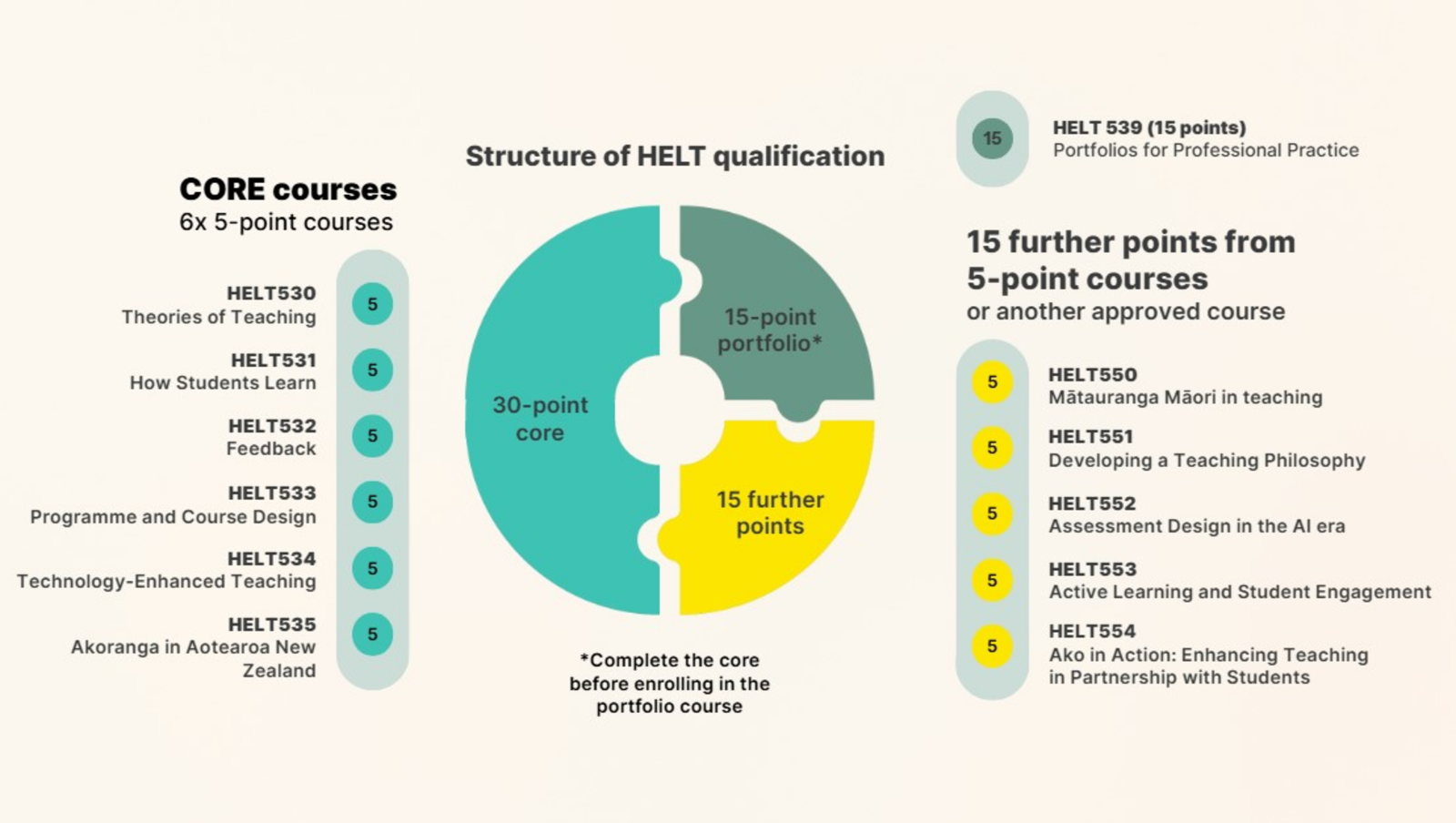
The HELT qualification comprises 30 points of core courses, a 15-point portfolio course, and 15 points from other courses.
The core of the HELT qualification consists of six foundational 5‑point courses that build essential knowledge in teaching and learning:
These courses form the 30‑point core and must be completed before enrolling in the portfolio course.
Learners reflect upon and develop a written portfolio:
Students select an additional 15 points from the following elective 5‑point courses to tailor the qualification to their interests: