
Ngā Kōrero o Paparahi—Tama Whiting
For designer Tama Whiting, place has always been central—not just as a location, but as a way of thinking.
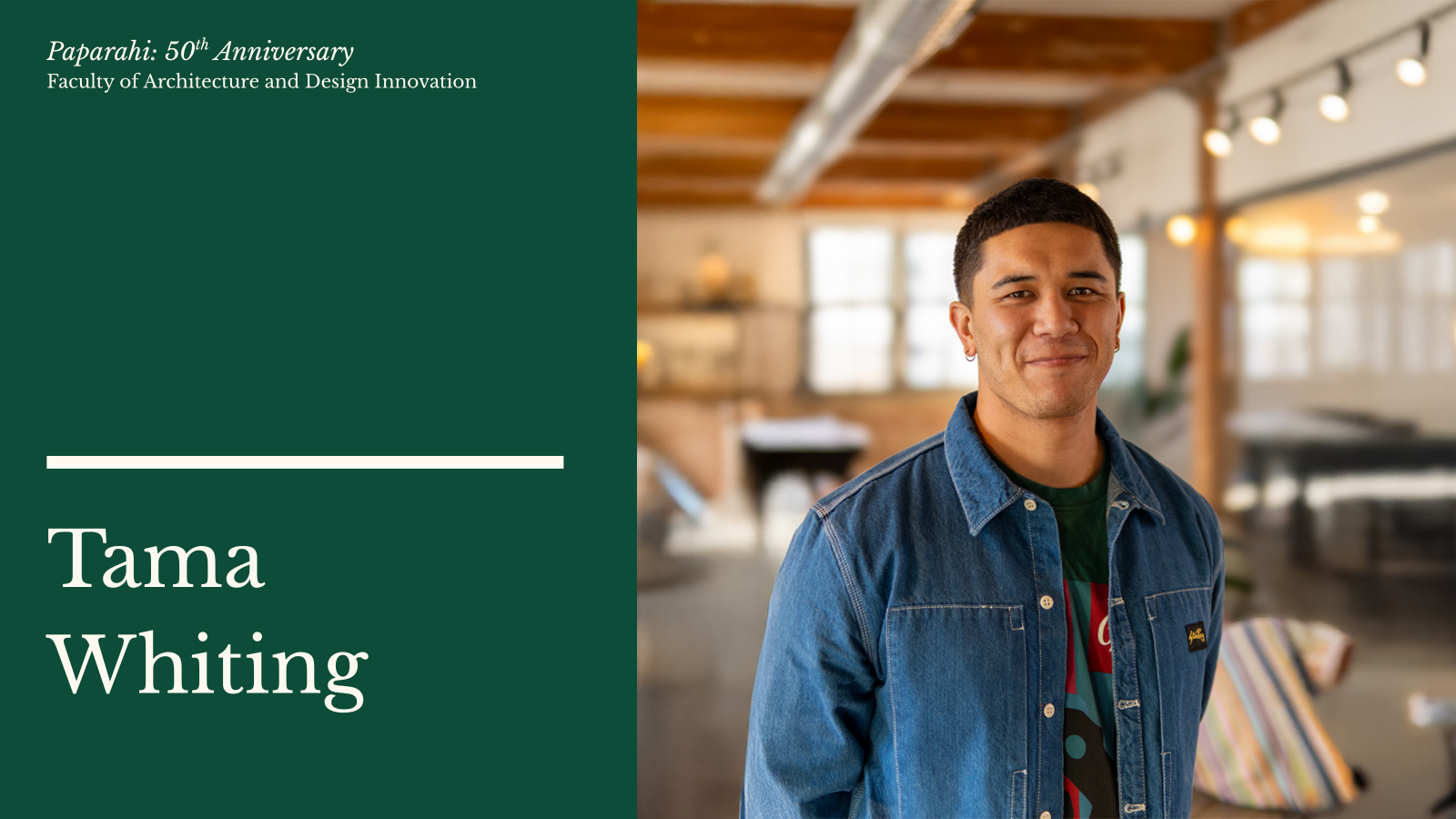
Born and raised in Wellington, he returned home after a year travelling and working on superyachts, ready to anchor himself in something creative.
“I always knew I wanted to ground myself in a creative field—I just didn’t know exactly where,” Tama says. “Victoria University stood out because of its cross-disciplinary design school. It gave me space to explore and figure out what felt right.”
Studying at the Faculty of Architecture and Design Innovation opened up a new view of the city he thought he knew. “Wellington is compact, creative, and unpredictable. Even though I grew up there, uni gave me a whole new lens. I met people from all over Aotearoa and loved showing them around my hometown.”
A studio project exploring the buried streams of Te Aro proved to be a turning point. “It made me think differently about what lies beneath our cities—ecologically and culturally,” he says. The project went on to be shortlisted in a major design competition in Melbourne. “That gave me confidence. It was the first time I saw our Aotearoa-based thinking resonate internationally.”
Tama now leads Indigenous-focused public design projects for global landscape architecture firm SCAPE in New York, weaving culture and ecology into large-scale urban environments across the Pacific. “It’s been a full-circle moment—connecting my roots in Aotearoa with my work overseas. Bringing Indigenous thinking into public projects and seeing that valued internationally has been incredibly rewarding.”
“Indigenous knowledge systems are being brought to the table more directly, not just referenced, but embedded. Design is becoming less about outputs and more about relationships: who’s involved, who benefits, and who carries the responsibility long term.”
It is this thinking that fostered a collaborative mindset during his studies. “Design isn’t a solo act. The best work comes from conversation, critique, and openness,” he says. “I left uni with the belief that lived experience matters, and that design doesn’t have to be fully resolved to be meaningful.
Now, Tama is encouraging current students to embrace that same collaborative, connected, and community energy. “Bring your full self to the work—your background, your culture, your weird side interests. That’s what makes your voice unique. Say yes to the unexpected. Travel if you can. Those experiences outside the studio will shape how you think.”