
Ngā Kōrero o Paparahi—Richard Clarkson
Richard Clarkson’s quest to produce quality design objects and installations has him reaching for the stars—and even working with them too
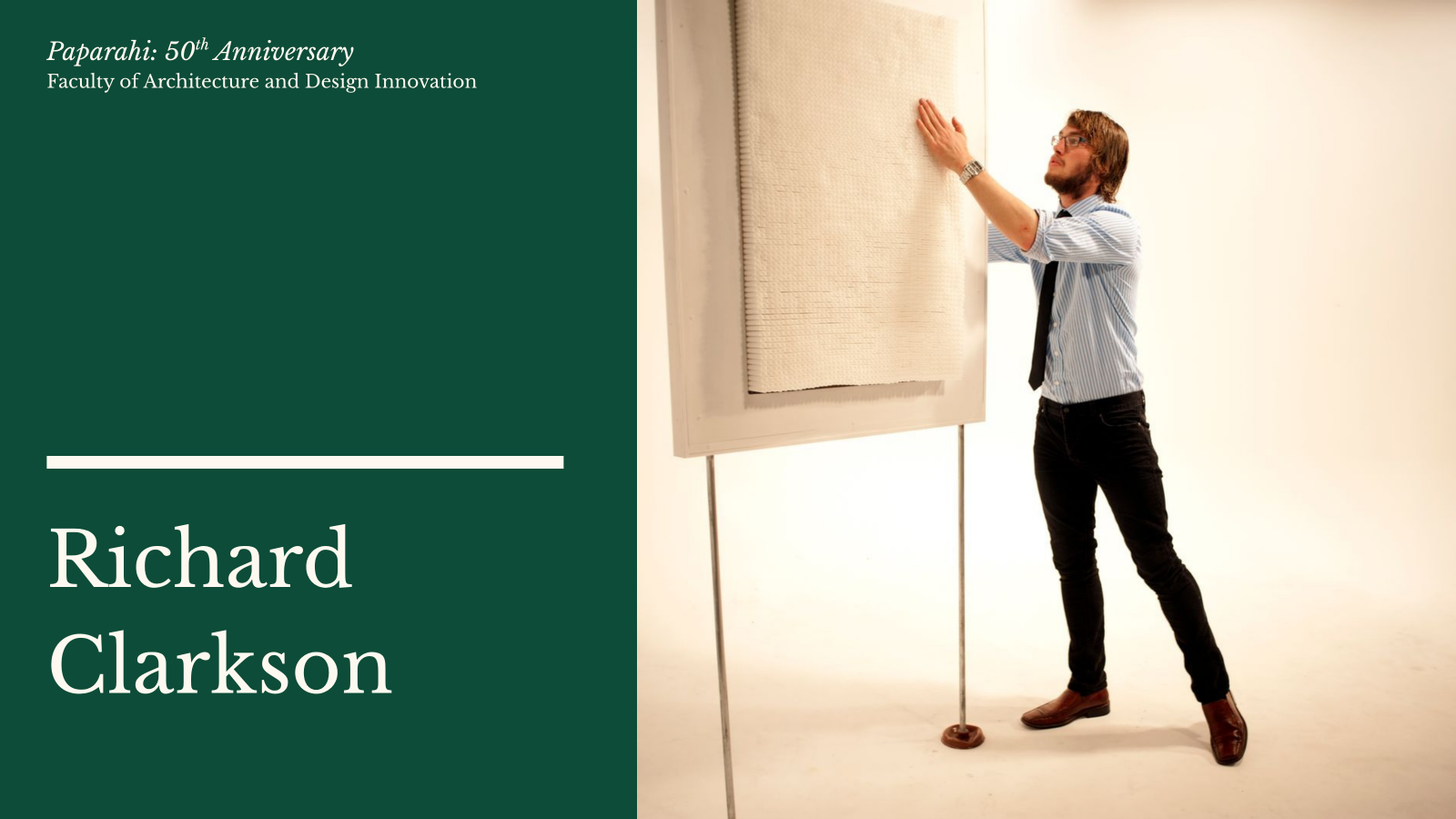
Finding a stray piece of gib board on the roadside during his design student days saw Richard Clarkson embrace a philosophy he continues to carry with him.
Tasked with bringing a random material from outside the campus to class at Te Herenga Waka—Victoria University of Wellington School of Design, Richard stumbled across the board on his way home one day. `
“The goal was to experiment on that material, to bend it, break, push it to its limits in every sense of the word and discover moments of interest where something unexpected or uniquely beautiful happened,” he recalls.
“These moments were the material telling us how it could be used in ways far beyond its original intention. That sort of idea has always stuck with me, that rather than forcing a material, concept or idea into something, sometimes it’s better to let it tell you what it wants to be.”
His sense of wonder was further heightened in his first year with another assignment using Computer Aided Design to craft a small sculpture for fabrication using laser cutters, then assembling and photographing it.
“I created a DNA helix-type object that appeared to be breaking free of its box and remember being mesmerised by each and every step of the process and feeling like design was the right fit for me.”
As the School of Design prepares to celebrate its 25th anniversary coinciding with its partner School of Architecture turning 50, Richard reflects on where finding the right fit has taken him.
The website for his business Richard Clarkson Studio, launched in 2014, carries the mission statement of being a “New York/New Zealand art & design laboratory whose pieces are inspired by the sky, the stars and the celestial”. If that all sounds a bit head in the clouds, be assured that Richard’s work embodies not just art and design, but science and engineering too.
“Our goals, values and aspirations have remained fairly constant throughout—to design objects, interactions, and installations that bring people joy and value,” he says.
His business, which boasts offices in both Madison Avenue, New York and his current studio in Porirua, designs everything from bookends, to pendants, to chandeliers, along with an array of other lighting products to create objects and installations “minimal in style, honest in material, elegant in simplicity, and sculptural to the core.”
It’s an aspiration steeped in design thinking that Richard has refined over time that could also hold a legacy for Aotearoa New Zealand.
“I think perhaps the biggest impact on Aotearoa’s future won’t be so much about the buildings and objects left behind, but the way we can discover and tackle new challenges using design thinking.”
His approach to design has even earned him the custom of celebrity clients.
“I got a call out of the blue from Miley Cyrus’ buyer saying Miley wanted to buy a Cloud for her home recording studio. I think I did a good job of playing it cool while we discussed the details, then once she hung up, I frantically called Em (my now wife) to celebrate.”