
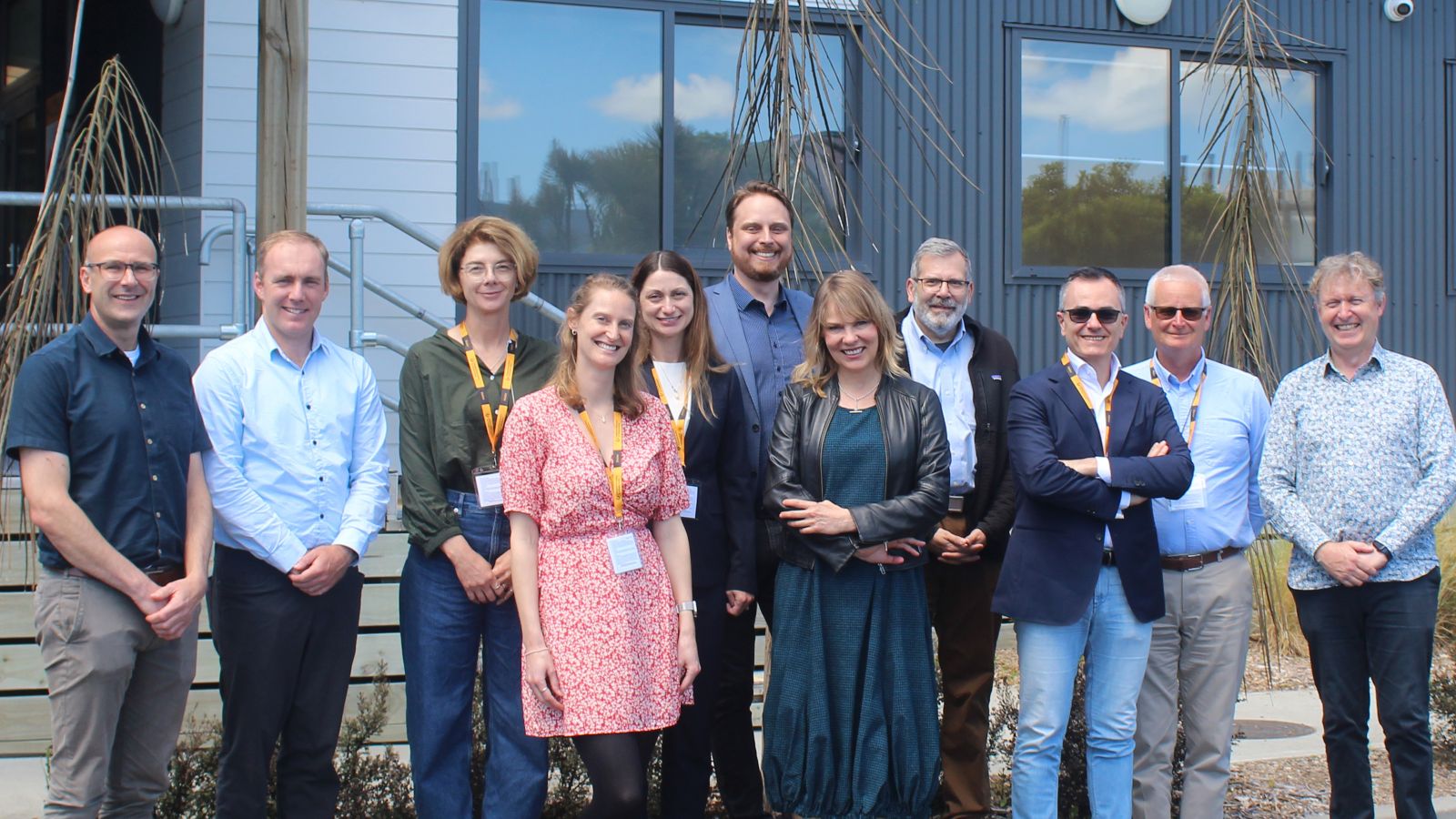
 Image: RNA Platform team (operations, pillar leads and scientific advisory), Photography by RNA team member, Katy Kelly
The New Zealand RNA Development Platform is designed as a national consortium of researchers, facilities, and industry partners working together to build world-class RNA capability. To achieve this, the Platform is structured around seven interconnected Pillars — each representing a critical stage in the journey from discovery through to clinical application.
The seven pillars
- Target Selection–Identifying the right disease targets using immunology, molecular biology, and computational tools. This is where discovery begins.
- Payload Design–Designing and optimising RNA payloads, such as mRNA or circular RNA, to instruct cells to make specific proteins.
- Formulation–Encapsulating RNA in lipid nanoparticles (LNPs) or other delivery systems to ensure stability and efficient uptake into cells.
- Preclinical Testing–Evaluating safety and effectiveness in models that predict how vaccines or therapies will perform in humans or animals.
- Quality Control (QC)–Ensuring every RNA product meets rigorous standards for purity, stability, and safety, with assays that can be transferred to GMP manufacture.
- Process Development and Manufacture–Scaling up from lab processes to manufacturing methods, including technology transfer to partners like South Pacific Sera for GMP production.
- Clinical Testing–Working with regulators and clinical partners to translate research into first-in-human and veterinary trials.
Integration across pillars
Each Pillar is interdependent — no single stage can deliver on its own. For example:
- Target Selection and Payload Synthesis feed into Formulation, which determines how well the RNA can enter cells.
- Preclinical Testing relies on high-quality formulations and QC data to provide reliable results.
- Process Development ensures that what works in the lab can be reproduced at scale.
- Clinical Testing closes the loop, validating discoveries and enabling real-world impact and relies on Manufacturing to produce suitable products in sufficient quantity.
This integrated model prevents silos and ensures that research projects contribute not just to science, but to building national capability across the full RNA development pipeline.
From Pillar projects to Flagships
- Pillar Projects: Smaller initiatives that strengthen individual Pillars (e.g. developing new lipid libraries or refining QC assays).
- Flagship Projects: Large, ambitious programmes that run end-to-end across multiple Pillars. These Flagships act as demonstrators of the Platform’s collective capability, tackling diseases of high importance to New Zealand such as influenza, staphylococcus aureus, or animal health vaccines.
Impact and outcomes
By structuring the Platform this way, New Zealand ensures it can:
- Rapidly respond to emerging health threats.
- Reduce dependence on overseas technology transfer.
- Build a sustainable innovation ecosystem spanning human, animal, and plant health.
- Strengthen resilience for future pandemics while creating opportunities for commercialisation.
In short, the Pillar structure is more than an organisational framework—it’s the engine room of New Zealand’s RNA future.