
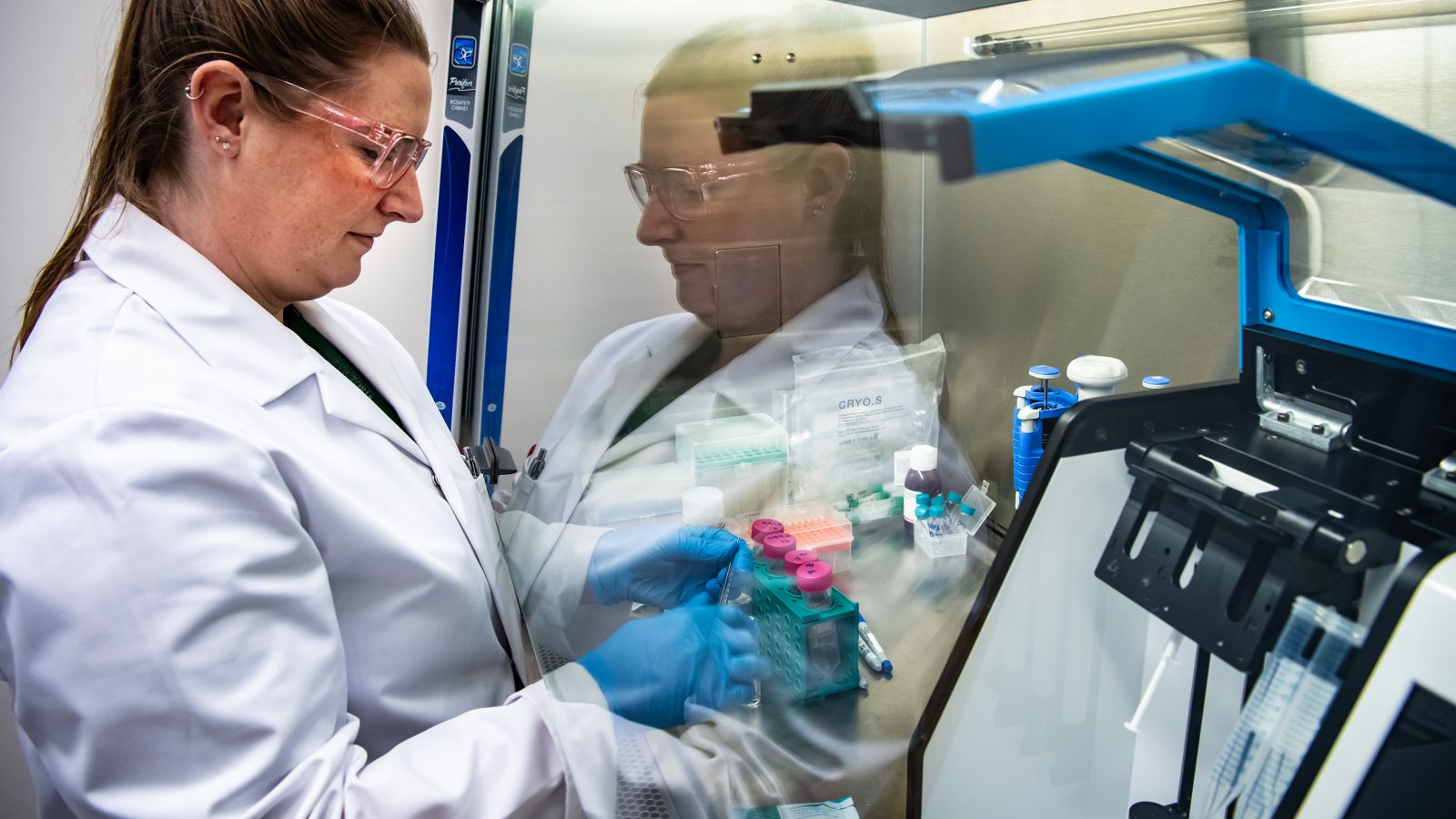
 Image: Dr Sarah Draper using NanoAssemblr Ignite system, Credit: VUW Image service
At the RNA Platform’s Development Facility, our team is tackling this challenge head-on by piloting the tools and processes that will bridge the gap between discovery and large-scale manufacture.
From Ignite to Blaze
Right now, the facility is running on the NanoAssemblr Ignite system—a benchtop instrument designed for early-stage research and small-scale production of lipid nanoparticles (LNPs). These tiny fat bubbles are essential for protecting and delivering fragile RNA molecules into cells, and they underpin everything from mRNA vaccines to antisense therapies.
The Ignite allows us to rapidly test new formulations and payloads, producing enough material for proof-of-concept studies and preclinical assays. But to support the Platform’s Flagship projects—and ultimately prepare for GMP (Good Manufacturing Practice) production—we need to move beyond pilot runs.
That’s where Blaze, a larger-scale NanoAssemblr system from Cytiva, comes in. Operated in partnership with South Pacific Sera (SPS), Blaze will enable production at volumes suitable for translational research and clinical-grade manufacturing.
Lessons at pilot scale
Scaling up isn’t just about making bigger batches. It requires solving a series of technical challenges:
- Process consistency–Ensuring the same formulation quality at 1 mL, 100 mL, or multi-liter scale.
- Analytical validation–Developing assays to measure size, charge, encapsulation efficiency, and stability of LNPs at scale.
- RNA stability–Testing how different RNA constructs behave in larger formulations, including self-amplifying RNA and antisense oligonucleotides.
- Technology transfer–Designing workflows that can be transferred smoothly to SPS, where GMP capability will be available.
- Regulatory readiness–Documenting methods and quality controls to meet the standards required for clinical use.
Significance of the facility
By starting small with Ignite and scaling up to Blaze, the RNA Platform is creating a continuous pipeline from laboratory research to real-world applications. This journey ensures that discoveries made by New Zealand scientists don’t stall at the benchtop, but instead move steadily toward translation, clinical trials, and eventual commercialisation.
In short, the Development Facility is more than a place for experiments — it’s the pilot plant for Aotearoa’s RNA future.