
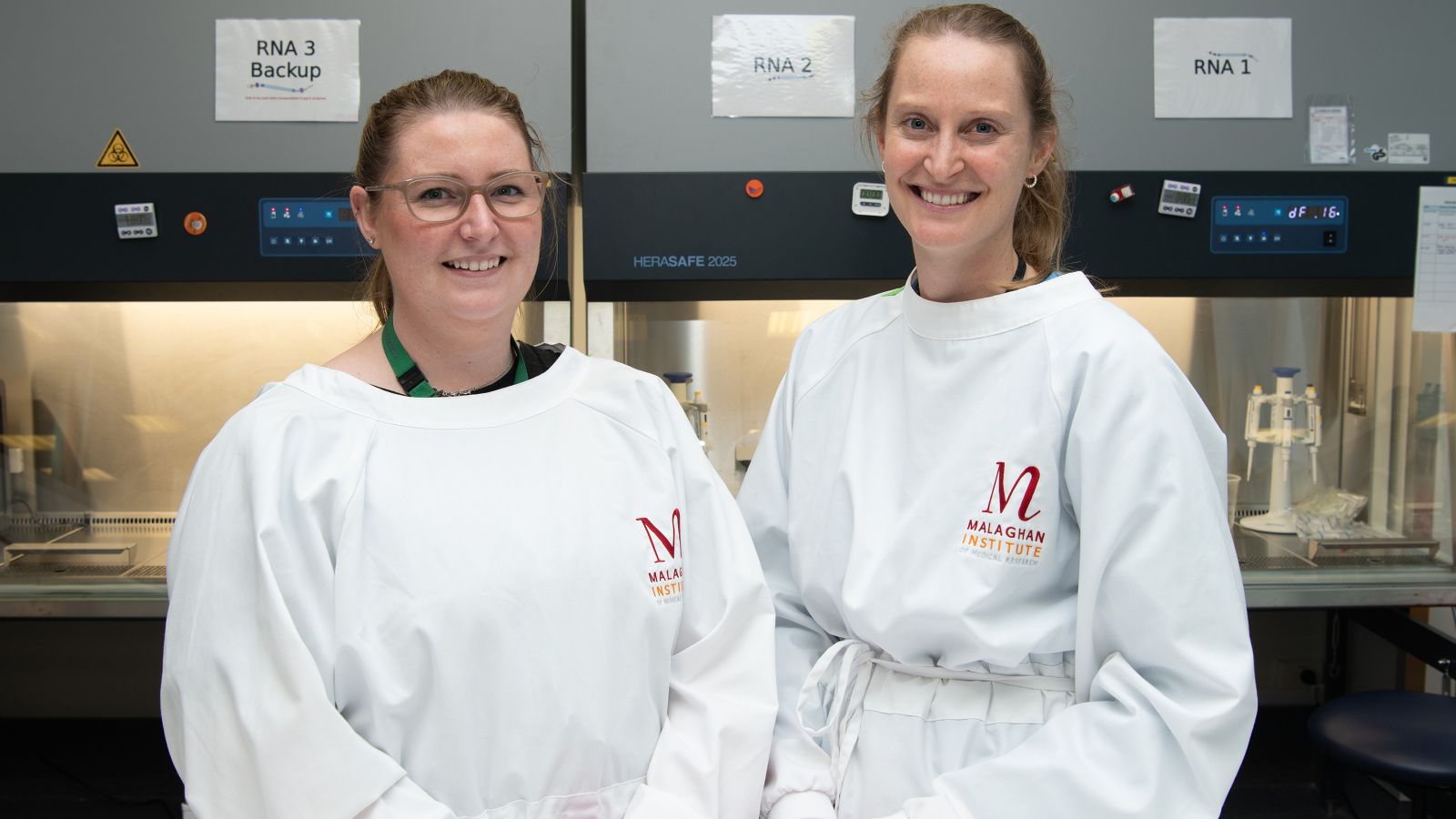
 Image: from left, Dr. Sarah Draper and Dr. Rebecca McKenzie
At the heart of the New Zealand RNA platform is the Central manufacturing facility, a national hub that ensures researchers across Aotearoa have access to the high-quality RNA tools they need to accelerate discovery and innovation.
A core part of the platform’s mission
The Manufacturing facility plays a central role in supporting the RNA Platform’s mission to build sustainable national capability for the development, manufacture, and commercialisation of RNA technologies in New Zealand.
The facility provides RNA and delivery vehicles for both in vitro and in vivo research, enabling projects that span from fundamental discovery to translational applications.
Fully operational and supporting research
The RNA Production Facility has been fully operational since September 2024 and is already supporting critical research efforts across the country. Managed by experienced Production Leads Dr Rebecca McKenzie and Dr Sarah Draper, the facility is positioned as a central hub for RNA technology in New Zealand.
It produces research-grade RNA—encapsulated in lipid nanoparticles (LNPs) where required — enabling research and development nationwide while also advancing manufacturing techniques for various RNA products.
Currently, the team is focused on producing messenger RNA (mRNA) and antisense oligonucleotides (ASOs), encapsulated in LNPs to ensure effective delivery for research applications. The first 250 samples have already been distributed to Fast Start and Pillar projects, providing a crucial resource for early-stage research.
As the Platform grows, the facility will expand its capabilities to handle a broader range of RNA modalities, equipping researchers across the motu with the tools they need to advance RNA-based technologies.
From fast starts to flagships
In its first year, the facility has prioritised Fast Start projects, supplying materials and technical support to accelerate early experiments. Looking ahead, this focus will shift towards the Platform’s Flagship projects and supporting the Pillar Leads as they establish their long-term work programmes.
By evolving alongside the Platform, the Manufacturing Facility ensures that researchers have access to the tools they need—not just now, but as the science and technology advance.
Commitment to quality and growth
The aim is clear: to provide high-quality, reliable materials for local researchers, while continuously improving product quality, analytical methods, and the range of offerings as the Platform matures. This ensures that New Zealand science can compete globally while remaining resilient in the face of future health challenges.
We have developed several QC methods to ensure that our RNA is of the highest quality. Below are some of the key properties that we test for and we have found that all our RNA constructs we made meet the industry standard.
Expert advisory support
Supporting the facility is Dr Steven Toms, who contributes as an advisor. A Principal Process Development Chemist at GlycoSyn, Steven has a diverse background in organic chemistry, spanning carbohydrates, dendrimers, peptides, natural compounds, and organometallics. His expertise in chemical process development, cancer research, and advanced methodology provides valuable guidance in solving complex challenges in quality control and manufacturing.
Teamwork and innovation
The Production Facility also benefits from a skilled and diverse team, including:
- Jochem Vink (Team lead)
- Caitlin McArthur (Malaghan Institute)
- Joanna Kuang (Malaghan Institute)
- Gabriella Davey (Malaghan Institute)
- Amy Foster (Ferrier Institute)
- Benji Compton (Ferrier Institute).
Together, they balance routine production (RNA, oligonucleotides, encapsulation, and QC) with development activities (new construct design, troubleshooting, process validation, and assay development).
Looking ahead
By investing in the Manufacturing Facility, New Zealand is creating not just a production pipeline for vaccines and therapies, but a platform for innovation. From pandemic preparedness to cancer therapies, regenerative medicine, and even agricultural RNA applications, the facility ensures that Aotearoa has the tools to lead on the global RNA stage.