
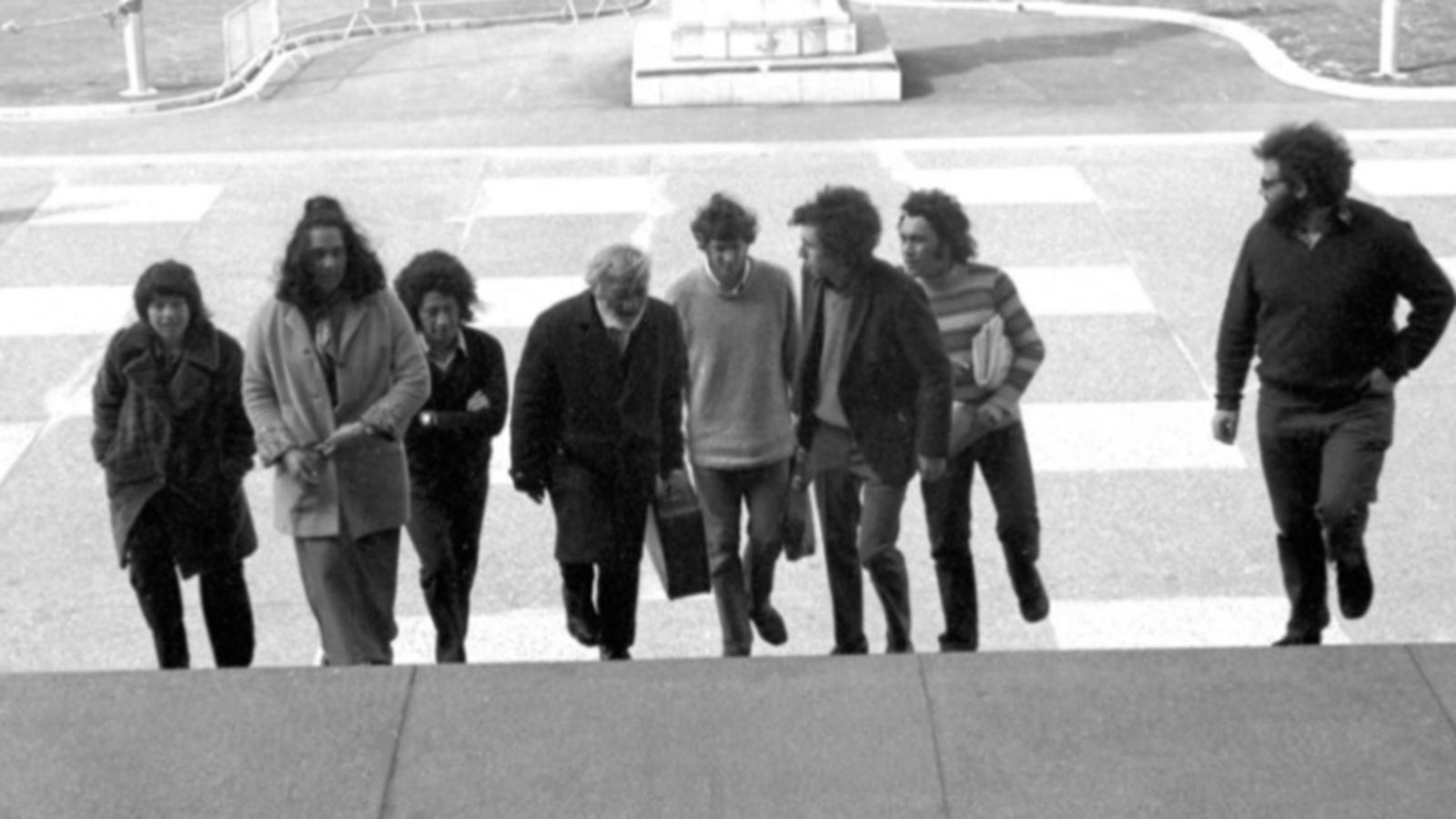
Te Petihana Reo Māori held a simple prayer: “that courses in Māori language and aspects of Māori culture be offered in all those schools with large Māori rolls, and that these same courses be offered as a gift to the Pākehā from the Māori in all other New Zealand schools as a positive effort to promote a more meaningful concept of integration.”
Te Ripowai Higgins was part of the signature-gathering movement. Her daughter, our Deputy-Vice Chancellor (Māori and Kaitiakitanga) Professor Rawinia Higgins (Tūhoe) was one of many Māori who couldn’t fluently speak te reo. Her mum was a native speaker, but her household language was English, and she learned te reo at Rūātoki, Aotearoa’s first bilingual school—the first fulfilment of the prayer of Te Petihana.
“Our interactions with our immediate and extended whānau were only ever in te reo. For me, they sounded really exciting, and juicy, and you could tell from their mannerisms and the way they laughed. It was such a hearty approach to engaging with each other,” says Rawinia.
“I just wanted to know what they were talking about. With that in mind, I went to my parents and said, ‘can I go to school in Rūātoki?’ My 11-year-old brain had interpreted bilingual as half the day must be in English, and half in te reo. But I arrived there to find out we’d be lucky to have an hour of English. It was closer to a modern-day immersion school.”
Te Rā o te reo Māori and further language commitments
The group who presented Te Petihana, which included over a dozen members of Te Herenga Waka’s Te Reo Māori Society, also put forward the idea of a national Māori language day, to promote an awareness of the language. This was first celebrated by Te Herenga Waka on 14 September 1973, with a gathering at the Student Union Building.
The first Māori Language Week was celebrated in 1975, a year after the 1974 amendment to the Māori Affairs Act 1953 that officially recognised the Māori language, and empowered the Minister of Māori Affairs to encourage the learning and use of te reo Māori in the public sector and more widely.
In 1987, te reo Māori was recognised as an official language of Aotearoa New Zealand, which gave speakers of te reo Māori the right to speak Māori in legal proceedings, and established Te Taura Whiri i te Reo Māori.
Rawinia’s daughter was educated at kōhanga reo and the immersion stream at Ōtari school. “It takes one generation to lose a language, and three generations to restore,” says Rawinia. “Regardless, you can still support it now.”
On 10 September, Rawinia in her role as Māori Language Commissioner, delivered ‘Towards a Million Speakers: The state of te reo Māori 2025,’ a speech about the progress Aotearoa has made since recognising te reo Māori as taonga.
Mātauranga Māori at Te Herenga Waka
Te Reo Māori and Māori studies were first offered by the Department of Anthropology at Te Herenga Waka in 1964 by Dame Joan Metge, Wiremu Parker (Ngāti Porou), and Te Kapunga (Koro) Dewes (Ngāti Porou). Professor Hirini Moko Mead (Ngāti Awa, Ngāti Tūwharetoa, Tūhoe, Tūhourangi) was appointed Chair of Māori Studies in 1977, and in 1981 established New Zealand’s first Māori Studies department.
Koro Dewes’ efforts and knowledge saw Te Herenga Waka—Victoria University of Wellington become the university of choice for students wanting to become fluent speakers of Māori in the late 1960s. In 1970, the University’s Te Reo Māori society was formed by Koro and Kura Dewes, with Pākehā and Māori founding members.
Te Herenga Waka marae was the first marae to be established in a New Zealand university. It opened at 36 Kelburn Parade in 1980 and in 1985, it was used as a venue alongside Waiwhetū marae in Lower Hutt for the Waitangi Tribunal Te Reo Māori Claim (WAI11), the findings from which led to a significant revitalisation of te reo Māori. In 1986, Te Tumu Herenga Waka opened, with Professor Hirini Moko Mead, Wiremu Parker, and the tohunga Ruka Broughton (Ngā Rauru) instrumental in its construction.
Fast forward 40 years, and Te Herenga Waka is home to Ngā Mokopuna, one of the world’s most environmentally responsible buildings, which houses the Office of our Deputy Vice-Chancellor Māori & Kaitiakitanga, Te Kawa a Māui, Āwhina, and Ngāi Tauira, as well as the Sustainability office.
When Rawinia did her undergraduate degree at Te Herenga Waka in the early 1990s, there was only a campus in Kelburn. “And we didn’t have this Ngā Mokopuna, we had one villa.
“We have the most Māori students we have ever had this year, many more than when I attended.”
Rawinia says they are still learning how to live in the building together. “We have karakia every morning, which allows everyone to come together and tell one another what’s going on but also use te reo Māori.”
The thing Rawinia is most enjoying is hearing and seeing students, and the energy they bring. “You can feel the buzz in the building. I want everyone to come over and experience it—this space isn’t just designed for Māori, it is for everyone to come together.”
“Language is a bridge, not a barrier”
Since 2016, Professor Rawinia Higgins has been the Deputy Vice-Chancellor (Māori) for Te Herenga Waka, leading Māori scholarship and growth at the University. She also holds the role of Māori Language Commissioner, and has positions on several boards.
As a leader of te reo Māori at Te Herenga Waka, she oversees Te mahere reo, Māori language plan. She feels positive about how te reo is developing here at the University.
“People are enthusiastically requesting Māori job titles, Māori names for initiatives. We have bilingual signage going up as old signage is replaced. Website headings are bilingual. Staff are also more able than ever to access te reo Māori through Te Hāpai, and formal courses in Te Kawa a Māui. People are wanting to improve themselves.
“Our Vice-Chancellor has introduced karakia as part of formal meetings, and little things like this help to move people along into a postive space, and normalise the language. You don’t need to jump in the deep-end of the pool—use the paddling pool first.”
Rawinia recently returned from Toronto, where she joined nearly 3,000 language advocates at the Waves 2025 Indigenous Language Summit, Canada’s first-ever Indigenous Languages Summit.
“My experience highlighted how far Aotearoa has come since the 1972 Māori language petition. Te reo Māori is now recognised internationally as a model for Indigenous language revival.
“When a language is visible, audible, and embraced in public life, it connects with not only its Indigenous speakers but all citizens. Language is a bridge, not a barrier,” says Rawinia.
While te reo Māori has had setbacks recently, Rawinia says that New Zealanders’ ongoing appetite for te reo Māori continues to give her hope. “One of the magical things I’ve noticed over the last couple of years, despite the political pushback, people still love te reo, and they still want to have access to it.”
New research from Te Māngai Pāho has shown a “powerful right shift,” showing that more New Zealanders are moving from disinterest towards active support of te reo Māori.
Demographic trends in Aotearoa mean that one-fifth of our population will be of Māori descent by 2040. “With the number of kura kaupapa and kōhanga reo, we are still underserving our population. These immersion schools are immensely successful, but we need more of them.”
Rawinia sees mainstream institutions like Te Herenga Waka holding an essential role in the sharing of mātauranga Māori. “The vast majority of Māori still come through mainstream schools to a mainstream university, so we need to be able to support them and all the choices they want to make.”
Te Taura Whiri i te reo Māori is aiming for 1 million te reo Māori speakers by 2040. The gains made in recent years, says Rawinia, are cause for hope. “When it comes to te reo, we have gone from protest to celebration. Let’s keep going.”
- Celebrate Te Wiki o Te Reo Māori 2025 at Te Herenga Waka
- Check out more photos of Te Reo Māori Society collected by Tapuaka Heritage & Archive Collections
- Read State of Te Reo Māori Report 2025
- Check out other opportunities to celebrate