
Special Issue published in commemoration of Lynda Petherick (1982–2022)
Following the sudden passing of former senior lecturer in Environmental Science Dr Lynda Petherick in early 2022, we have honoured her memory through research contributions at upcoming conferences and in a journal Special Issue.
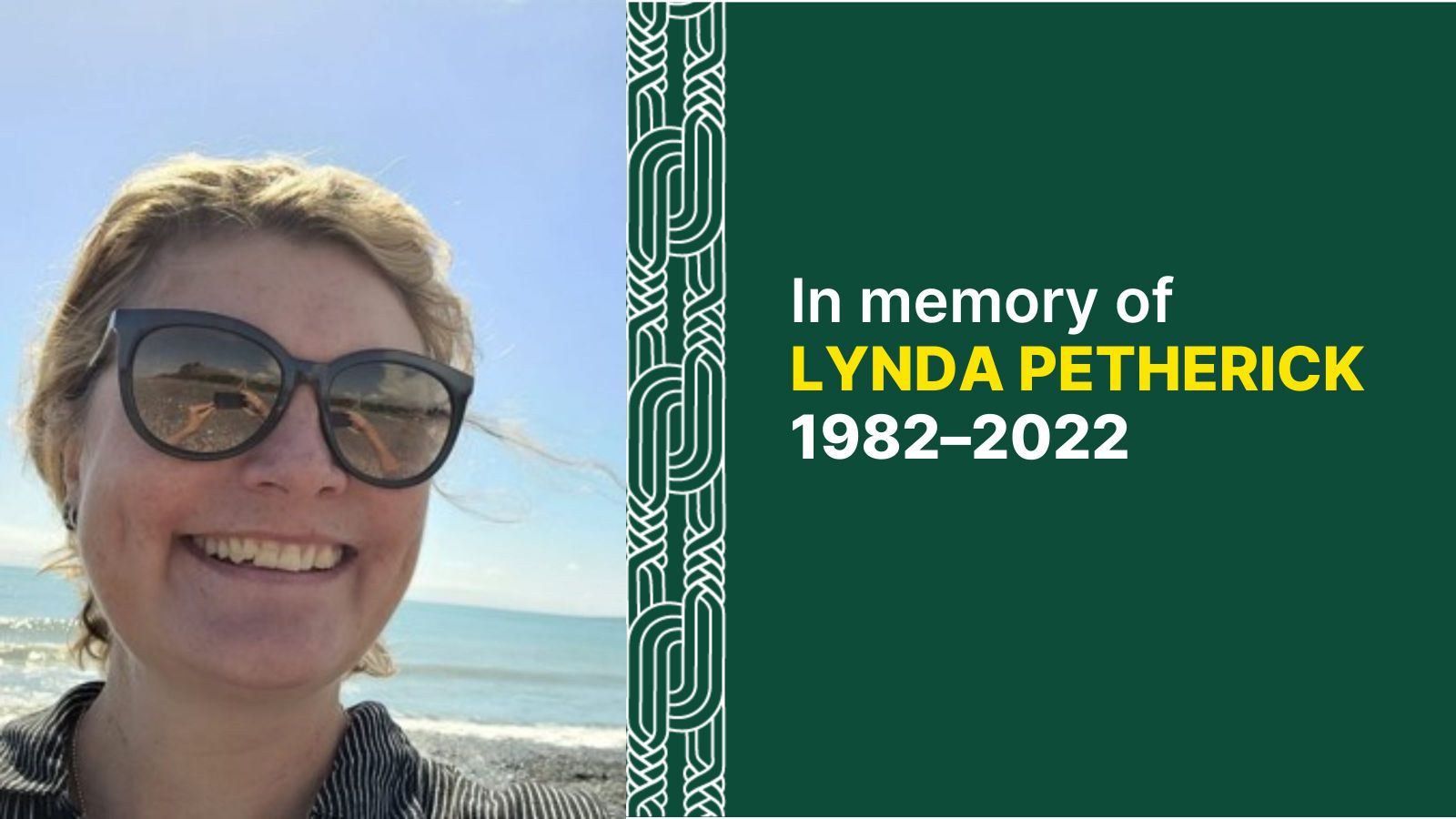
A complete Special Issue of the Journal of Quaternary Science has now been published online in Lynda’s honour. In addition, the publisher, Wiley, has produced a bound hard copy of the full Issue, which will be gifted to Lynda’s parents. The following text provides a brief biography of Lynda’s career and is included as the preface to this bound copy.
After completing undergraduate (Atmospheric Science) and Honours degrees (Physical Geography) in New Zealand, Lynda moved to Brisbane, Australia, for postgraduate study. There, she completed her MPhil and PhD at the University of Queensland (UQ), developing her interest in environmental and climate change during the late Quaternary and laying the foundations for her career in academia. At UQ, she developed specialisms in analysing far-travelled dust, geochemistry, sediment grain size, pollen, and charcoal. From these proxies, her PhD (and subsequent research) enabled her to reconstruct past dust transport pathways and associated synoptic-scale conditions over eastern Australia during the past 40,000 years. Later, she was to develop further expertise in climatic and environmental variability in the Southern Hemisphere during the last glacial maximum, as well as Holocene sea level change and coastal evolution in tropical Australia.
Following a post-doctoral research fellowship at Queensland University of Technology (2011–2013), she worked as a lecturer in Environmental Science at Xi’an Jiaotong—Liverpool University, China (2013–2016) before taking up a lectureship at Victoria University of Wellington to lead a then nascent programme in Environmental Science. This appointment enabled Lynda to return to the region where she spent much of her childhood, including her secondary schooling and where her parents still live. Under her inspiring leadership, the Environmental Science programme grew from strength to strength to the extent that at the time of her passing, it represented one of the most successful new degree programmes developed at the University in recent times.
Lynda’s leadership also extended to her research community. She was elected as Vice-President of the Australasian Quaternary Association (AQUA) in 2018, and then President from 2020—a post she still held at the time of her passing. In this role, Lynda instigated some important reforms in AQUA’s processes and approaches, including developing a new mentoring scheme and the promotion and representation of women, minorities, and early career researchers. Through these various roles and activities, Lynda’s influence has been extraordinarily broad and impactful for one whose career was cut so tragically short. Through the pages of this Special Issue, you will find glimpses of her far-reaching influence, and its publication symbolises her esteem among Southern Hemisphere Quaternarists in particular.
These words from Professor Hamish McGowan, one of her supervisors at UQ, were read at Lynda’s funeral. They capture much of the essence and vitality of our dearly beloved colleague and friend.
“The things that stick in my mind about Lynda, as I’m sure they will for many, was her infectious enthusiasm for research, her laugh and smile, which could turn a bad day in the field into an okay day and a good day into a great day. She just loved her research during her MPhil and PhD, whether it was standing waist-deep in a leech and snake-infested swamp or driving 1,000 km in a day through the Outback. She was an outstanding demonstrator in class and an inspiration for many young women in physical geography here at UQ. Her contribution to Quaternary Science and aeolian geomorphology will stand the test of time and will be a lasting legacy of her hard work and passion for her studies. Lynda was an inspiration on how to live and enjoy life to the fullest, whether at work or play—a lesson that many of us should learn.”