
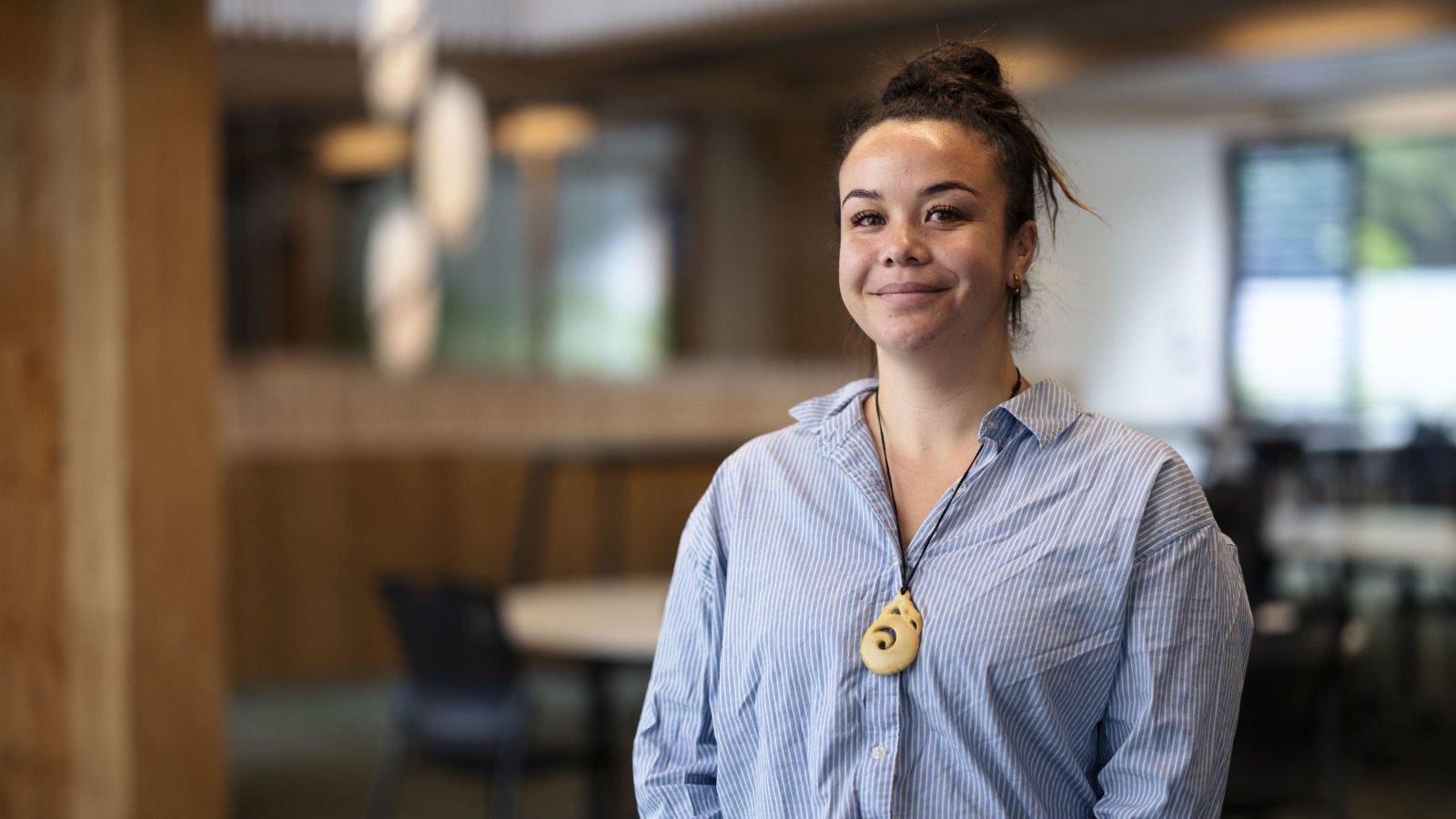
Growing up in Paekākāriki, where she continues to live today, Dr Annie Te One spent lots of time with her whanau who were engaged in iwi work throughout Te Whanganui a Tara.
It was in part her experience supporting pōhiri, mihi whakatau, and ceremonial events throughout the region that inspired her to pursue Māori Studies at Te Herenga Waka—Victoria University of Wellington as an undergraduate student.
“Ever since then, I’ve been really interested the roles of universities in teaching and researching in areas of Māori politics, and Te Kawa a Māui has been a natural home for this to happen. As a lecturer, I feel really privileged that I get to have kōrero and wānanga with tauira about aspects of rangatiratanga and how this relates to political contexts throughout Aotearoa.”
As she becomes the first wāhine Māori from the mana whenua iwi in Wellington to be appointed as tumuaki of Te Kawa a Māui, she is excited about the potential of working in Ngā Mokopuna.
“There is a far more visible connection to the whenua here now that Ngā Mokopuna exists. We can see parts of Kumutoto awa, the wharenui is more visible and this encourages more people to think about the history of this whenua and the ways we choose to live and work on and with it.”
Ngā Mokopuna was opened in December 2024, and is in the final stages of its journey to become a certified Living Building™. The living building challenge is the world’s most stringent sustainability certification that a building can receive. The petals of the certification mirrors Te Herenga Waka—Victoria University of Wellington’s own Māori values: kaitiakitanga, whanaungatanga, whāi matauranga, manaakitanga, and akoranga.
Dr Te One is enjoying sharing the space with the community.
“We are in an interesting period at the moment, where Ngā Mokopuna is still quite new for our community, and people are really interested, not just in the sustainable elements of the building itself, but the values that Ngā Mokopuna encourages us to think about in terms of climate change, politics and the future of our society. It helps us to think about what it can mean to work in line with values like kaitiakitanga and manaakitanga.
“It is also giving us the opportunity to centre Te Tiriti o Waitangi in the space. Part of this is making te reo Māori a more heard language—and having more conversations about how Aotearoa as a whole might shift to a more sustainable, more te Tiriti-led governing structure.”
As new students enter Ngā Mokopuna, Dr Te One says they enjoy how welcoming it is. “In the wharekai in particular, there’s always something going on. I think one thing that’s really nice for us as Te Kawa a Māui is that we are more physically connected to students than we used to be.”
Between beginning as a student at Te Kawa a Māui and returning as a lecturer, Dr Te One completed her thesis at the Australian National University, on the topic of mana whenua, mataawaka, and local government. She continues to research and study kaupapa Māori politics, and recently contributed to the Mana Wāhine Waitangi Tribunal enquiry.
“This claim is massive—trying to document since prior to Te Tiriti o Waitangi, the numerous impacts of colonisation on wāhine Māori and our whanau. Dr Carrie Clifford, Dr Maia Berryman-Kamp and I together researched and wrote a report on what this has looked like in the public service and the Crown’s political domain.
“We found that wāhine Māori have been severely under-represented throughout the public sector for many years, and that this is often coupled with layers of discrimination.”
The Mana Wāhine hearings continue later in 2026, and will carry on throughout the next few years, before the release of the final report. This will provide a documentation of wāhine Māori that has never existed before, that can serve as a basis for ways to respond to documented inequities.
Dr Te One has also been participating in a large multi-stakeholder project called Generation Kāinga which has been exploring the kāinga realities and experiences of rangatahi Māori from throughout the country, which aims in part to redress the current lack of rangatahi voices influencing housing policy. They are currently in the process of publishing the findings.
“We found that rangatahi Māori are acutely aware of the challenges of colonisation and capitalism that have shaped equitable access to safe and secure housing. We also found they had numerous ideas to offer about how housing might better respond to concerns like climate change and cost-of-living pressures.
“Working in Ngā Mokopuna as a sustainable building is actually a really exciting example of what this can look like, and what opportunities are already available.”
As a māmā of three young tamariki, Dr Te One is committed to ensuring that they grow up knowing the importance of their whakapapa, te reo Māori, and what kaitiakitanga can look like in many spaces.
“I think my family are proud of me,” says Dr Te One. “I feel really fortunate that I get to work on the whenua my tūpuna are from. I am privileged to get to lead Te Kawa a Māui in this new building and be a part of shaping what Māori Studies at Te Herenga Waka will look like in the future.”