
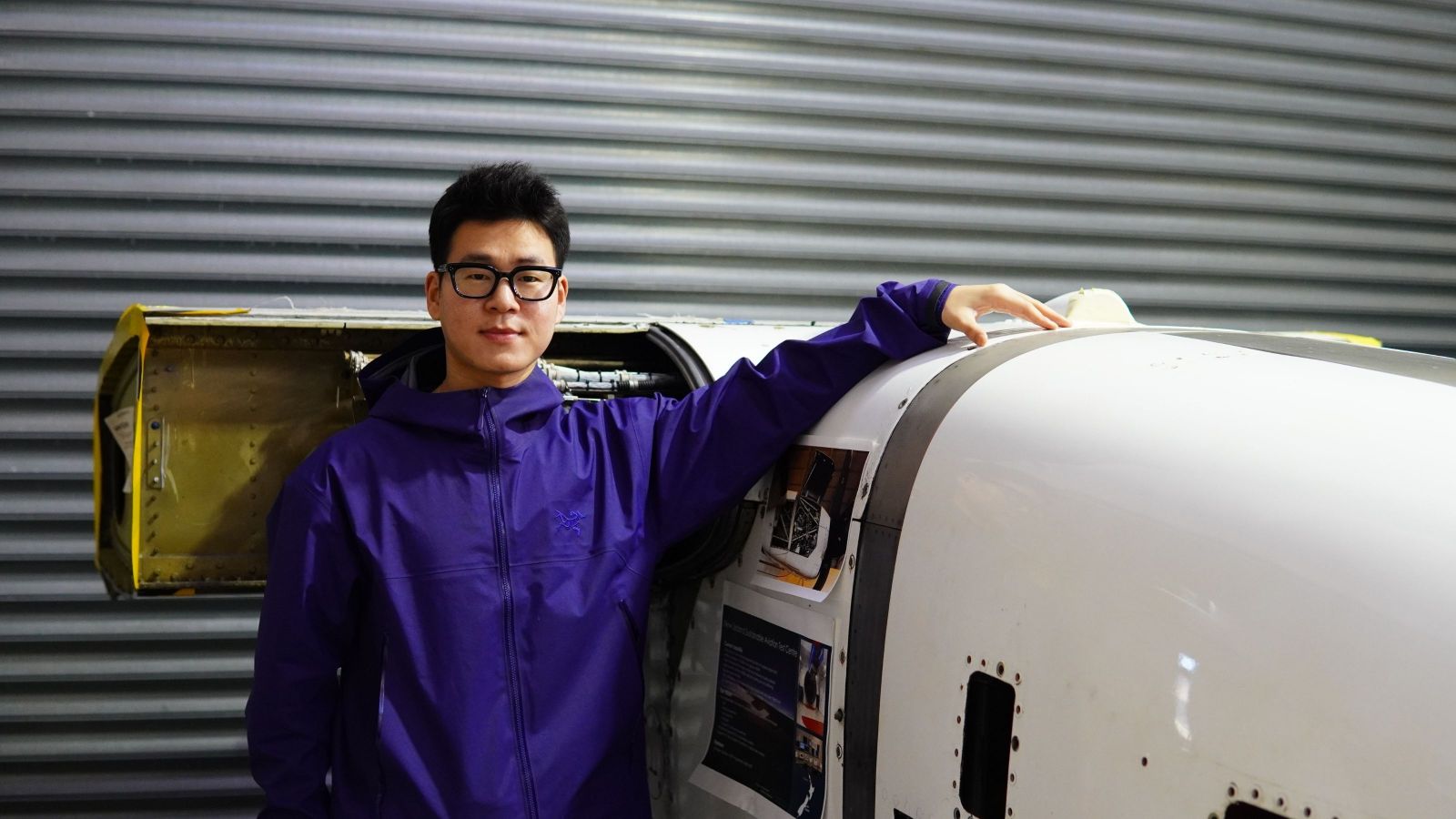
I research the small things that will help get us one step closer to being able to fly across the world without melting the icecaps.
At a time when the aviation industry is under pressure to cut carbon emissions, researchers working at both Paihau–Robinson Research Institute and around the world are exploring how electricity could power the planes of the future.
I came to New Zealand from completing my earlier degrees in electrical engineering in Beijing and joined the Robinson lab to complete my PhD.
We’ve all felt our phone or laptop warm up during use. That heat is energy that isn’t doing useful work. In superconductors, we might expect zero energy loss under DC conditions. However, when they are exposed to alternating electromagnetic environment, they still produce heat through what’s known as AC loss. This is what I tried to reduce with my research in the context of superconductor-based rotating machines and their parts.
Rotating machines made of superconducting materials offer advantages of high-power density, low weight, and high efficiency, which mean they are promising candidates for use in all-electric aircraft. However, the substantial energy loss in the form of heat when transporting AC current or when exposed to AC magnetic fields is a challenge underpinning its development.
I wanted to understand this energy loss, work out how best to measure it accurately, and how to reduce it. I knew that if I did this well, what I found may help engineers design lighter and more efficient electric machines. If they do this, this will reduce the volume of liquid nitrogen or liquid helium required to meet their top operating efficiency.
Science is all about testing different ways of achieving a goal, and when I started this PhD, I was starting from scratch. I had to design the experiments, making mistakes along the way and recording and publishing them for others to learn from. In my first year of my PhD, I tried to measure the critical current of round superconductors in one way for over six months—only to have to try a new method when the first one failed.
Electric planes are already a reality, but the technology hasn’t reached the scale that is needed to build planes that can hold multiple passengers and fly long routes. If we can understand where the waste energy goes and how to reduce it in the application of superconducting technology, we can design rotating elements that use less power, weigh less, and are safer. That helps make electric flight not only possible, but practical.
My research more specifically, was estimating two superconducting materials for their AC loss levels when they are used in windings in rotating machines. These materials were Conductor on round core (CORC) cables and magnesium diboride (MgB2) wires, with variable qualities.
This is the first time these materials have been simulated for superconducting rotating machines in a realistic way, under the conditions that replicate their use in an all-electric aircraft.
My findings provided the mathematical and numerical data of CORC cables for field windings and twisted multifilamentary MgB2 wires with non-magnetic sheath for armature windings. This can be largely used to predict realistic opportunities of use in all-electric aviation.
My research may be technical, but its goal is simple: to reduce waste and improve energy transition in superconducting technologies that will shape our low-carbon future.
Whether it is electric planes, greener public transport, or more sustainable ways of using energy, the kinds of tools that I have developed are key to designing systems that are both effective and climate friendly.
Since completing my PhD, I have been fortunate enough to be able to continue my research as a research fellow at Robinson, while also working with the superconducting magnet team towards a project transforming satellite propulsion.
Originally published in the Sunday Star-Times Brainwaves feature. Read the original on The Post.