
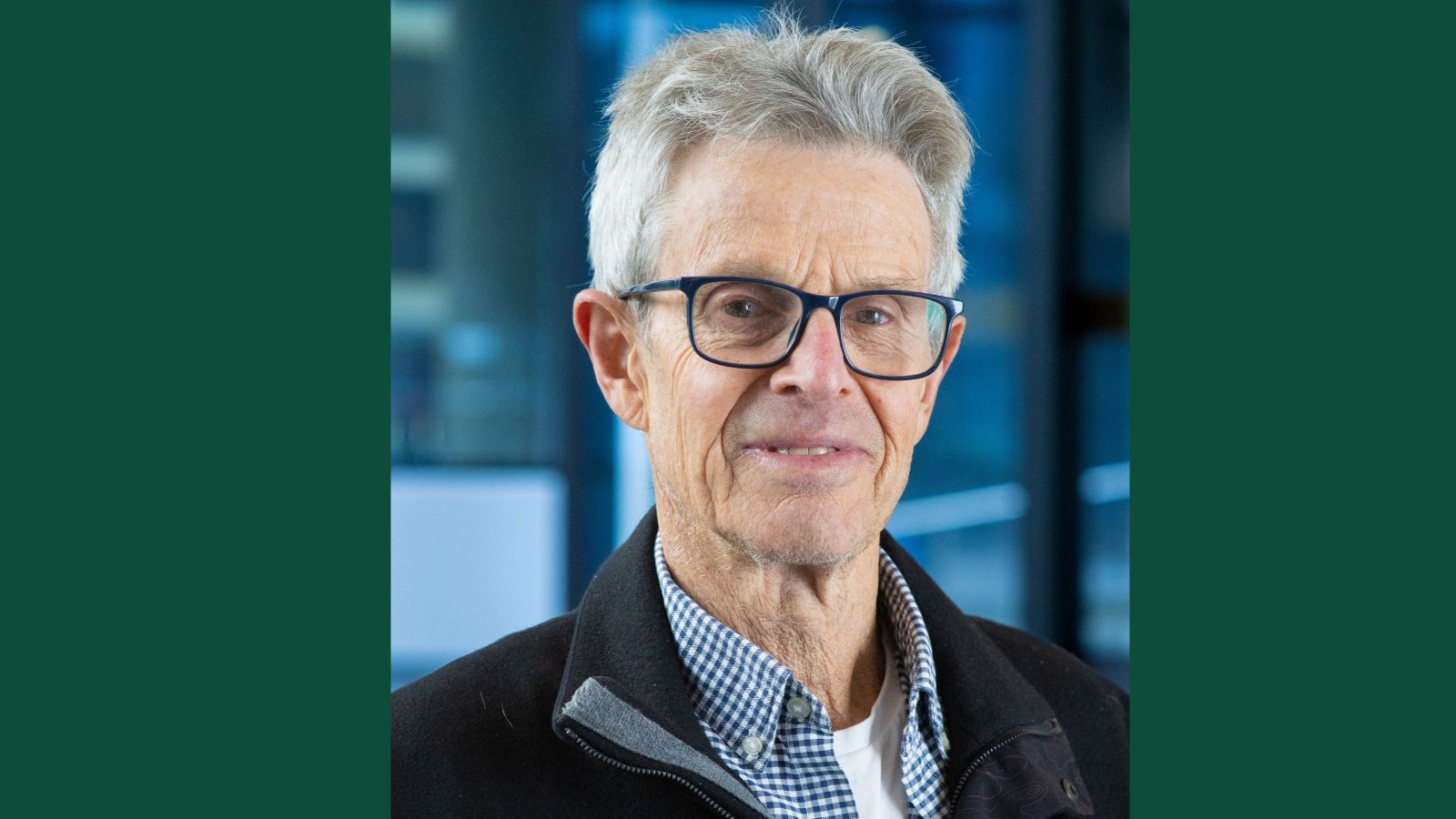
Since he joined Te Kura Tātai Aro Whenua—the School of Geography, Environment and Earth Sciences 34 years ago, Tim’s research has contributed to the field of geophysics and led to new understandings of plate tectonics. He has co-led several international research projects that have provided groundbreaking insights into the deep structure of Earth on a global scale, but also much closer to home.
As a youngster, Tim wanted to combine his passion for mountaineering and the outdoors with his love of numbers, and he thought earth sciences would be the way to do that. He studied geology and geophysics at Victoria and mathematics at Canterbury University, worked at the DSIR ( the national science research agency at that time), and did a stint in the United States before returning to Victoria to start his academic career in 1992. He was mentored early in his career by global geophysics leaders Professors Frank Evison, Dick Walcott, and Dr Trevor Hatherton. " They were demanding and tough to work with, but I feel privileged to have had the opportunity to work with them.”
Tectonics in Antarctica
Tim’s work has taken him around the world, including sabbaticals in the United States and the United Kingdom, as well as research trips to Antarctica. When he was just 23, Tim was asked to lead a gravity survey as part of an expedition to the frozen continent.
“I was fascinated with Antarctica, and was lucky to be sent there for a couple of months to traverse around the Taylor Glacier and right up onto the East Antarctica ice cap,” he explains. “I loved every aspect of Antarctica—living in the tents, cooking together and heading out by yourself each day with no radios or any way of communicating, which you’re not allowed to do these days. But back then it was just me and my gravity meter, which was very exciting for a 23-year-old.”
It was this expedition that really ignited Tim’s passion for learning as much as possible about the fundamental science behind how the earth works, and was the first of eight Antarctic expeditions over the course of his career.
After finishing his PhD he worked in the United States on post-doctoral programmes at Cornell and Stanford Universities, which led to his first international research collaboration.
“The collaborative study with Stanford looked at how continental mountain ranges are formed. It turned out Antarctica was a good place to research that because the Transantarctic mountains are on a tectonic boundary, and the icy conditions mean the mountains are less eroded and better preserved,” says Tim.
“We had three large expeditions down there as part of that project, and we’d work for a month at a time setting off underground explosions and recording the waves that came back. That gave us an image of the surface of the plates, and shed light on the processes that formed the mountains on the surface.”
The Alpine Fault ‘cushion’ and the Hikurangi experiment
When that project was completed, Tim could see New Zealand held a lot of potential for geophysics research, in particular the Alpine Fault, which straddles the Australian and Pacific continental plates. Together with some colleagues from the University of Southern California and the Massachusetts Institute of Technology, he embarked on a major geophysical experiment called SIGHT—the South Island GeopHysical Transect.
The team used seismographs to measure the echoes from underground explosions laid across the fault line, and from airgun shots off the coast of the South Island. The huge amounts of data that were gathered over three years helped the team create an image of the Alpine Fault at depth and learn about how the plates moved against each other.
The SIGHT project enabled the scientists to identify where the base of the crust lay, and they also found evidence that there may be a large section of high-pressure fluid within the base of the crust—somewhere between 8 and 35 kilometres deep.
“It’s a profound geophysical anomaly, but it suggests that the mid-section of the Alpine Fault might act kind of like a cushion,” he says, meaning that quake magnitudes may be buffered, taking a magnitude 8 down to a magnitude 7.
Another of Tim’s big international collaborations significantly advanced the understanding of how plate tectonics actually work. The SAHKE (Seismic Array Hikurangi Experiment) involved installing 1000 seismographs spaced 100 metres apart between the Kāpiti and Wairarapa coasts, and more on the bottom of the ocean.
Surprisingly, the reflected vibrations measured by the experiment revealed a channel about ten kilometres thick of gooey material at the base of the plate, which was about 100 km beneath the lower North Island. The character of reflections from this layer suggested the channel is partially melted rock, squashed between the plate and the mantle beneath it.
“This would be a slippery, frictionless, layer that permits the plates to slide around like a ski on snow,” explains Tim. “There is a long standing question in plate tectonics of how the plates move when you’d expect there to be a lot of drag at the base of the plates. So we were able to provide a plausible solution to this, and thus make a contribution to the puzzle of what makes plate tectonics work.”
The team’s findings were published in the main Nature scientific journal—Tim says it remains one of his research highlights.
“It was a satisfying achievement, and funnily enough we didn’t even set out to look for it at all, he says. “That’s the nature of good science—you need to put yourself in a position where serendipity can play a part.”
Hammering in the cake tin
In the last few years Tim’s focus has moved to solving a pressing problem in his own backyard.
“I realised Wellington got in a bit of a pickle after the Kaikōura earthquake in 2016—we got a lot of damage but it was confined to certain areas in the CBD. I wanted to know why,” he says. “The city is built on a sedimentary basin but not much was known about the shape or depth of it. But I knew from basic physics that if you get waves trapped in a basin of low-seismic wave-speed sediments they start to resonate like echoes in a cave.”
Tim funded a student to conduct a gravity survey—the last time a survey had been done in the CBD was in the 1960s, and the advent of technology like GPS meant Tim and his student could make much more accurate measurements.
Tim roped in his 300-level Applied Geophysics class on the project to complement the gravity survey by gathering seismic reflection data using mechanical hammers. The best places to do that were parks, including Wellington’s waterfront stadium. Although Tim claims the damage he inflicted to the stadium turf was “no worse than what an All Black scrum would do”, it did earn him a telling off from the groundskeeping team who didn’t let him come back the next day.
But getting banned from the stadium was worth it—the information Tim was able to gather from that and other spots around Wellington showed the basin was twice as deep as previously thought. The deeper the basin, the higher the amplitude of the amplified seismic waves.
The project also showed that edge of the basin was not where it was previously believed to be, but instead runs from Lambton Quay, past the railway station, up past the stadium, and to the Interislander Ferry terminal. This is important as what’s called an ‘edge effect’ means shaking is strongly amplified adjacent to the edges of a basin.
He says the edge effect explains why some areas of the city were worse affected than others in the Kaikōura quake—and he hopes his findings will help leaders make important decisions around risk planning for any future earthquake events.
The privilege of being an academic
Tim has run, or co-run, the applied geophysics course at Te Herenga Waka for nearly 30 years—in that time he has supervised more than 75 postgrad degrees and taught around 500 students in his 300-level geophysics course.
His achievements in research were recognised with his appointment as a Fellow of Royal Society of New Zealand in 2007 and as a Fellow of the prestigious American Geophysical Union in 2012, which he says was particularly satisfying.
Although pulling back from duties at Victoria, Tim will continue travelling regularly to Shanghai, where he’s working with a former PhD student on a joint project about the Transantarctic Mountains and the Great Escarpment in Africa, which used to be joined in the time of the ancient supercontinent, Gondwanaland.
Reflecting on his academic career, Tim feels very lucky.
“Being an academic is a real privilege. I’ll always regard it as that—it’s a real privilege to be able to make a contribution to fundamental knowledge about the earth and maybe make a difference to people’s lives.”