
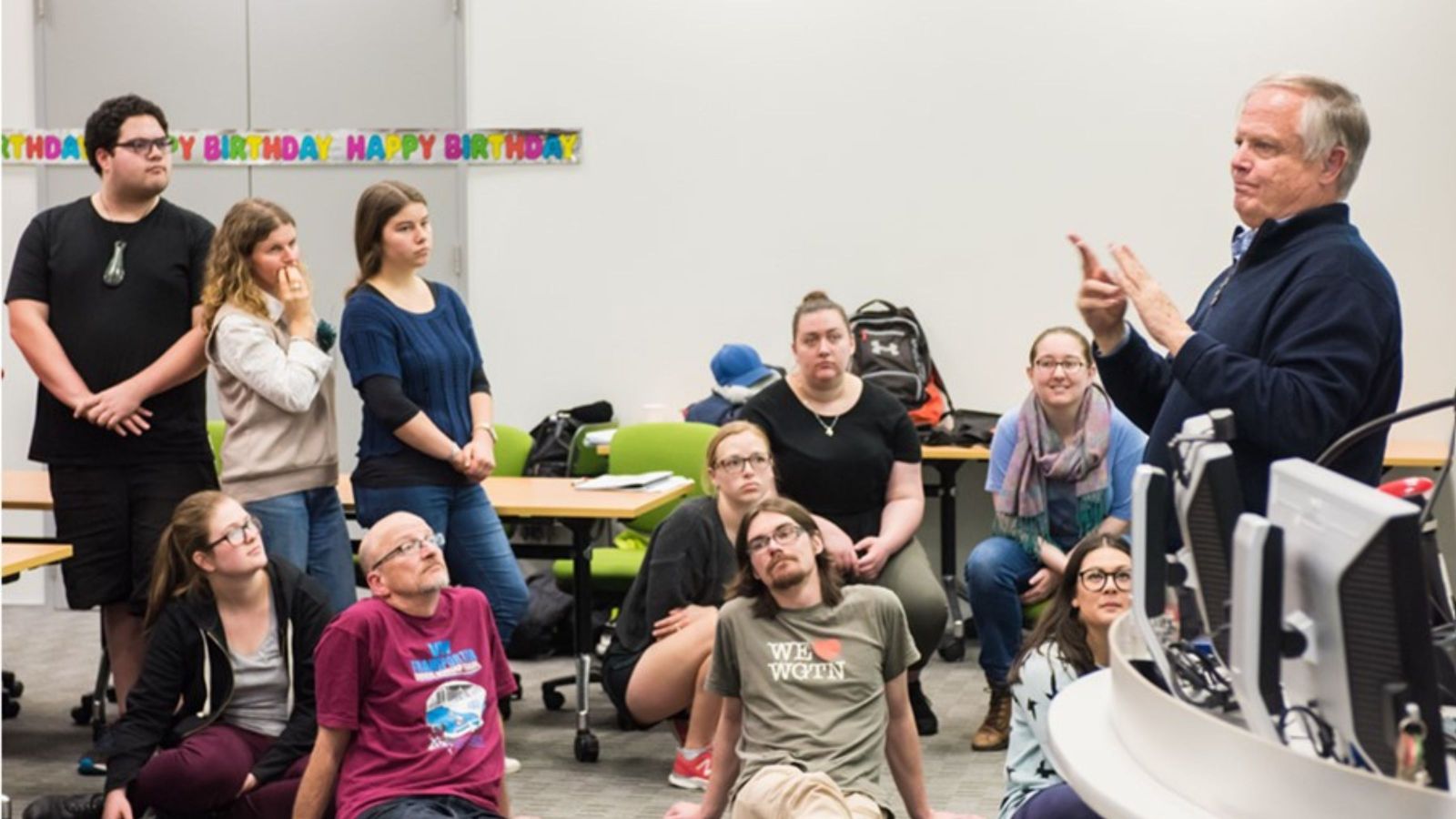
“I was really quite shocked and surprised to receive the honour,” David says. “I've done a lot of work on New Zealand Sign Language here in New Zealand, but it's very nice to be acknowledged for that lifetime of work. I feel very honoured to be recognised in that way.”
David’s journey as a Deaf educator and researcher spans decades. Alongside his wife, Dr Rachel McKee, he co-founded New Zealand’s first NZSL‒English interpreter training programme at Auckland University of Technology (AUT) in 1992. This pioneering initiative laid the foundation for the country’s only degree-level qualification in sign language interpreting, ensuring that Deaf New Zealanders have access to skilled interpreters who understand the cultural and linguistic nuances of the community.
“I've always been very interested in language from my time in America where I started out teaching American Sign Language and linguistics,” says David. “Then I moved to New Zealand with my wife, Rachel, where we work together as a team. I could see that sign language had very low status and there were only three sign language interpreters in the country at that time.
“So we established the training of sign language interpreters, which expanded the pool of interpreters available. The interpreters gave deaf people a lot more access to things like higher education. Even just normal life services, like going to the doctor without having to write.
“Deaf people have access to all sectors of New Zealand life today. For example, we're seeing an interpreter standing beside the Prime Minister or politicians, even in that very public domain, which is putting a spotlight on the language and raising its status.”
David’s research played a pivotal role in the recognition of NZSL as an official language of New Zealand in 2006—a milestone that affirmed the language’s legitimacy and the rights of its users.
“From the training of sign language interpreters, we then went on at Victoria University to train deaf people as language teachers to increase the pool of deaf people who could teach the language, which then means you're increasing the number of people in society that can sign.”
Beyond academia, Dr McKee has been a steadfast advocate for Deaf-led governance and community empowerment. He has served on the NZSL Board and chaired the Deaf Aotearoa Holdings Board, where he contributed to strategic planning, language development, and access initiatives across the country. His leadership has helped ensure that Deaf voices are central in decisions that affect their lives, from education to public policy.
Growing up, David attended a school for the deaf where sign language was not officially allowed to be used in the classroom.
“It was forbidden and the focus was on speaking and listening, and it was very much a struggle. Once we got out of class we used sign language secretively amongst ourselves, but in class we had to try and lip read the teachers, which was really difficult to do. We couldn't hear the teachers.
“Once I got to high school, I did have some deaf teachers who used sign language, which was amazing. That just opened up the world for me. So that was a huge change and that that was when I really became a committed signer.”
David is a bilingual signer, having grown up with American Sign Language, and then learning New Zealand Sign Language when he moved to New Zealand.
“I was lucky to attend a deaf university, Gallaudet University in Washington, DC, which is the only university in the world specifically for deaf students. There everybody signed all the time, including the cafeteria and the dorms and the offices and the bank.
“It was a whole immersive sign language world for me. So that was kind of like a utopian environment for sign language user.”
An important part of David’s and Rachel’s work has been making the online Dictionary of NZ Sign Language, the number one web resource that people are accessing to learn New Zealand Sign Language. The dictionary is designed for sign language learning in a user-friendly way.
“I think the availability of that through our work has had a big impact,” David says. “It's been quite an important resource for the language.”
David is now retired, but remains on the NZSL Online Dictionary editorial team, and holds an Adjunct role in the Deaf Studies Research Unit. In 2020, Dr McKee was awarded life membership of NZSLTA.
Champion of New Zealand Sign Language receives CNZM honours
Dr David McKee was recently appointed a Companion of the New Zealand Order of Merit (CNZM) in recognition of his lifelong dedication to advancing New Zealand Sign Language (NZSL), deaf education, and linguistic rights in Aotearoa.