
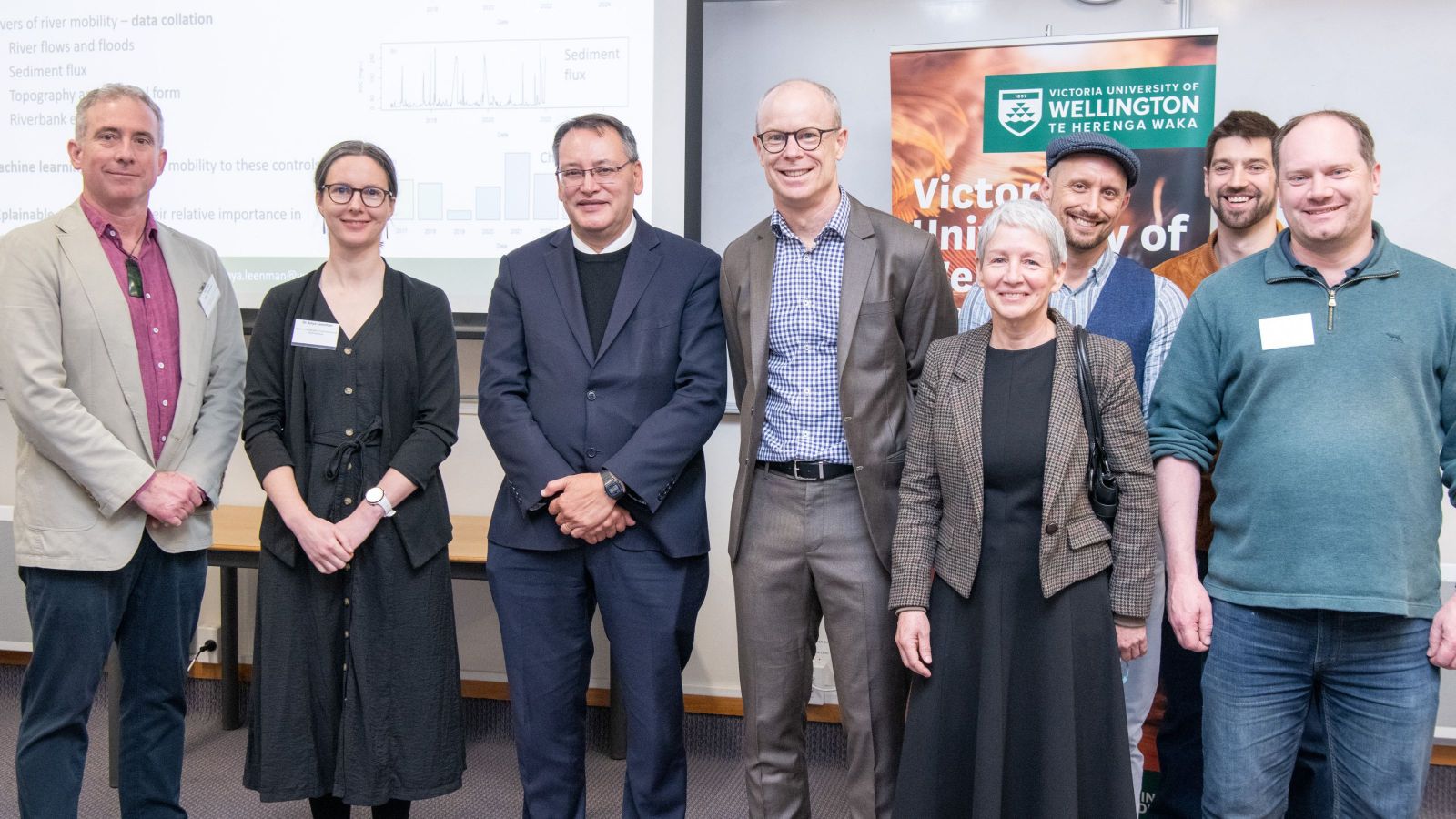
This was announced by Minister for Science, Technology and Innovation, Dr Shane Reti, at the University’s Kelburn campus on Tuesday this week. The Minister also engaged and interacted with the researchers whose projects have been successful in this round.
The research that is being funded includes projects exploring the impact of climate change on river mobility, leveraging machine-learning to improve the accuracy of forecasting volcanic eruptions, designing microwave circulators that can improve quantum computers by miniaturising a key component, and looking at lakes as natural seismometers towards estimating seismic hazards. A brief overview of the projects is as below:
Dr Anya Leenman: Modelling environmental drivers of remotely-sensed lateral river mobility
Anya’s project will measure the lateral mobility of rivers nationwide. Combining satellite data and machine learning, her team will also model the environmental controls on lateral river channel mobility, and ultimately explore the potential impacts of climate change. It is expected that climate change will impact river flows and the size of floods, but there is little understanding about how these hydro-climate changes might accelerate or slow down river mobility in Aotearoa. Anya’s project will explore how lateral river mobility is likely to be affected by climate change. Such an understanding of lateral river mobility is crucial for spatial planning, flood risk, and insurance.
Dr Finn Illsey-Kemp: Machine-learning tools for forecasting volcanic eruptions
Finn’s project aims to explore how machine-learning can be used to improve the forecasting of volcanic eruptions. As many parts of New Zealand are exposed to volcanic hazards, much of the potential risk can be mitigated through accurate forecasting. Currently, volcanoes are monitored using different techniques and volcano scientists use multiple data-streams concurrently to forecast the probability of eruptions, which is complex. This project will develop new machine-learning tools to jointly analyse all the available data about New Zealand's volcanoes.
Dr Jackson Miller: An on-chip microwave circulator for scalable quantum computing
Jackson’s project will explore the design and manufacture of miniaturised microwave circulators, a critical piece of quantum computing infrastructure. Quantum computers require sophisticated microwave control electronics, but microwave components are large, limiting the number of quantum bits that can be leveraged to solve problems. Using the special properties of rare-earth nitride materials, Jackson’s team will investigate chip-scale microwave circulators that could dramatically reduce the size of quantum computing's auxiliary components, removing large energy overheads and facilitating the scale up of quantum computers.
Associate Professor Jamie Howarth and Professor John Townend: Benchmarking earthquake hazard estimates using novel natural seismometers in lakes
This project will explore a novel approach towards independently evaluating seismic hazard forecasts. The National Seismic Hazard Model plays an important role in reducing the impact of earthquakes in New Zealand. This includes informing decisions around infrastructure, insurance pricing, and societal preparedness. The model must be validated using known earthquake events to test its performance over a long enough time period to include earthquakes of a range of magnitutes. However, since modern sensors can’t provide the long-terms records required for model validation, this project proposes using lake sediments as natural ‘seismometers’ to create these records.
The project, focusing on Lake Rotoroa and Lake Tūtira which record earthquakes from the Alpine Fault and Hikurangi Subduction Zone, will use advanced technology like fibre-optic seismology and sedimentary DNA on sediment cores spanning nearly ten thousand years.
Speaking about the announcement, Professor Margaret Hyland, Deputy Vice-Chancellor, Research, said, “This is a wonderful announcement and I’m very pleased that the innovative and forward-thinking nature of these projects have been recognised. These Smart Ideas have their genesis in excellent curiosity-driven research. By exploring new ways of thinking our researchers will be advancing their research to deliver real world impact.
“We were delighted to have Minister Reti join us on campus and engage with our researchers,” she said.
With a total of 46 projects funded under the Smart Ideas category this year, Te Herenga Waka’s success rate of 36.4% ranks higher than the national average of 28.6%.