
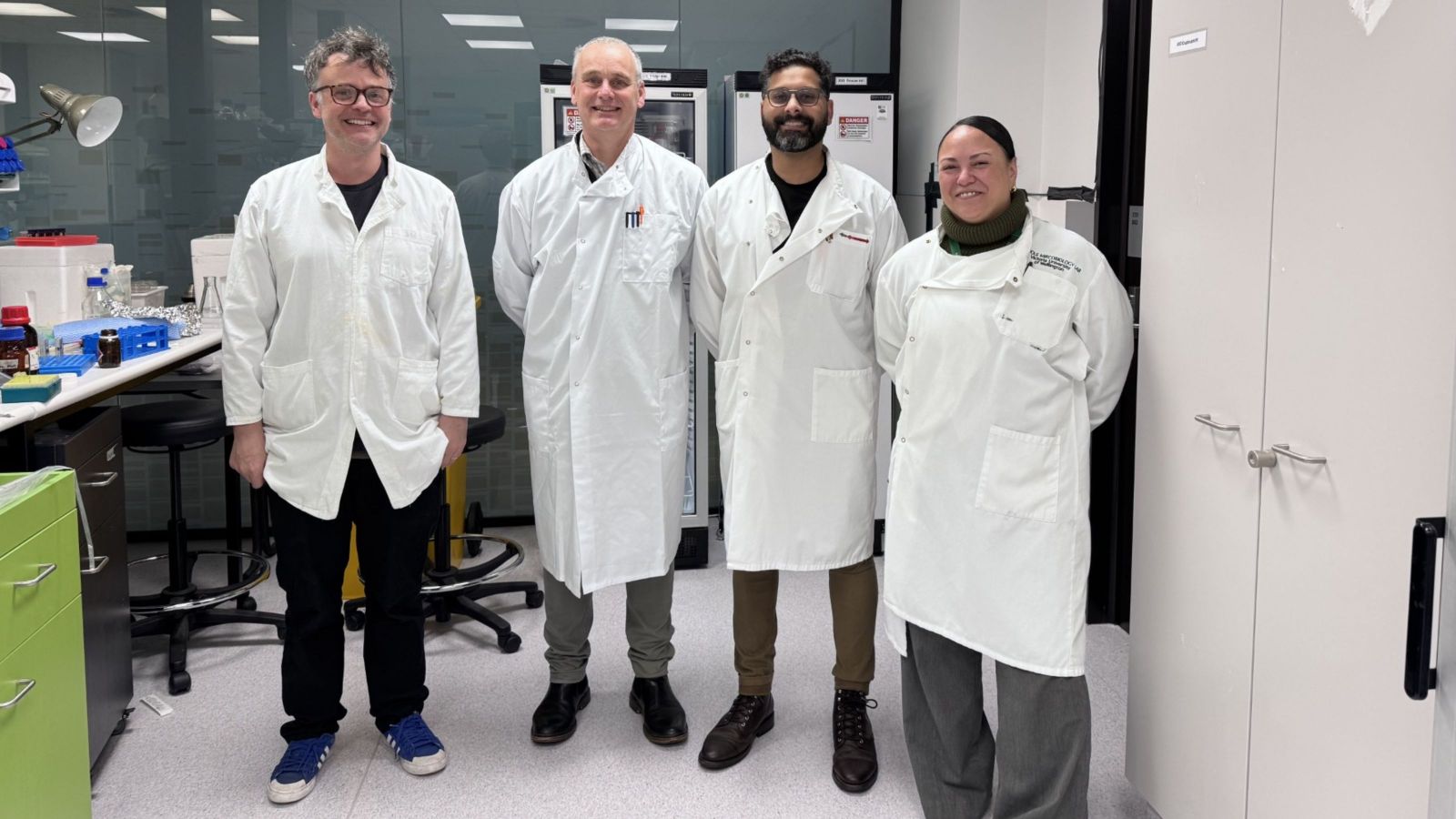
Titled Accelerating Innovation in Marine AI-powered Bioprospecting (AIMARIA), the four-year research project will see Dr Jeremy Owen, Dr Jonathan Singh, Dr Helen Woolner, and Associate Professor Robert Keyzers work closely with leading partners to explore how advances in AI and synthetic biology can be leveraged to support the discovery of new marine natural products.
Natural organisms play a crucial role in drug discovery, and chemical compounds produced by such organisms are often the starting point in developing new drug leads to treat a range of human conditions. The production of these chemical leads is controlled by biosynthetic enzymes that are encoded in the genomes of bacteria, plants, and many invertebrates. In the marine environment, invertebrates like sponges, corals, and other animals produce bioactive natural products, or contain microorganisms that synthesise them.
However, a vast portion of the biosynthetic potential in our oceans remains unexplored. This is particularly true of microorganisms that can’t be cultivated under laboratory conditions, or in cultivatable microbes that often go ‘silent’—where the pathway to natural product production is switched off. Access to, and the development of, valuable bioactive natural products produced by marine microorganisms remains limited.
The research programme aims to support the discovery of new marine natural products, by integrating AI‑driven prioritisation, digital twin technologies, AI‑enabled predictive DNA design, and cutting-edge synthetic biology. This approach will create sustainable, scalable pathways to high‑value marine natural products and the discovery of new classes of bioactive compounds and enzymes.
“We’re honoured to be part of this successful Horizon Europe programme. Being part of this collaboration highlights Te Herenga Waka’s growing global reputation and leadership in marine biotechnology and sustainable innovation. It showcases Aotearoa New Zealand’s research excellence on the world stage and positions our University at the forefront of the emerging blue bioeconomy,” says Dr Jeremy Owen, who will lead the Te Herenga Waka team.
“Given the multidisciplinary nature of the research, our team will include researchers from the School of Biological Sciences, the School of Chemistry and Physical Sciences, and the Centre for Biodiscovery. It’s very exciting to have the opportunity to collaborate with researchers from across Europe.”
Led by the Norwegian University of Science and Technology (NTNU), AIMARIA includes partners such as ETH Zürich, Wageningen University, and Imperial College London. The team’s expertise ranges from natural products chemistry and biosynthesis, microbiology, enzymology and biocatalysis, quantum and computational chemistry, chemo- and bioinformatics, and includes partnerships with industry.