
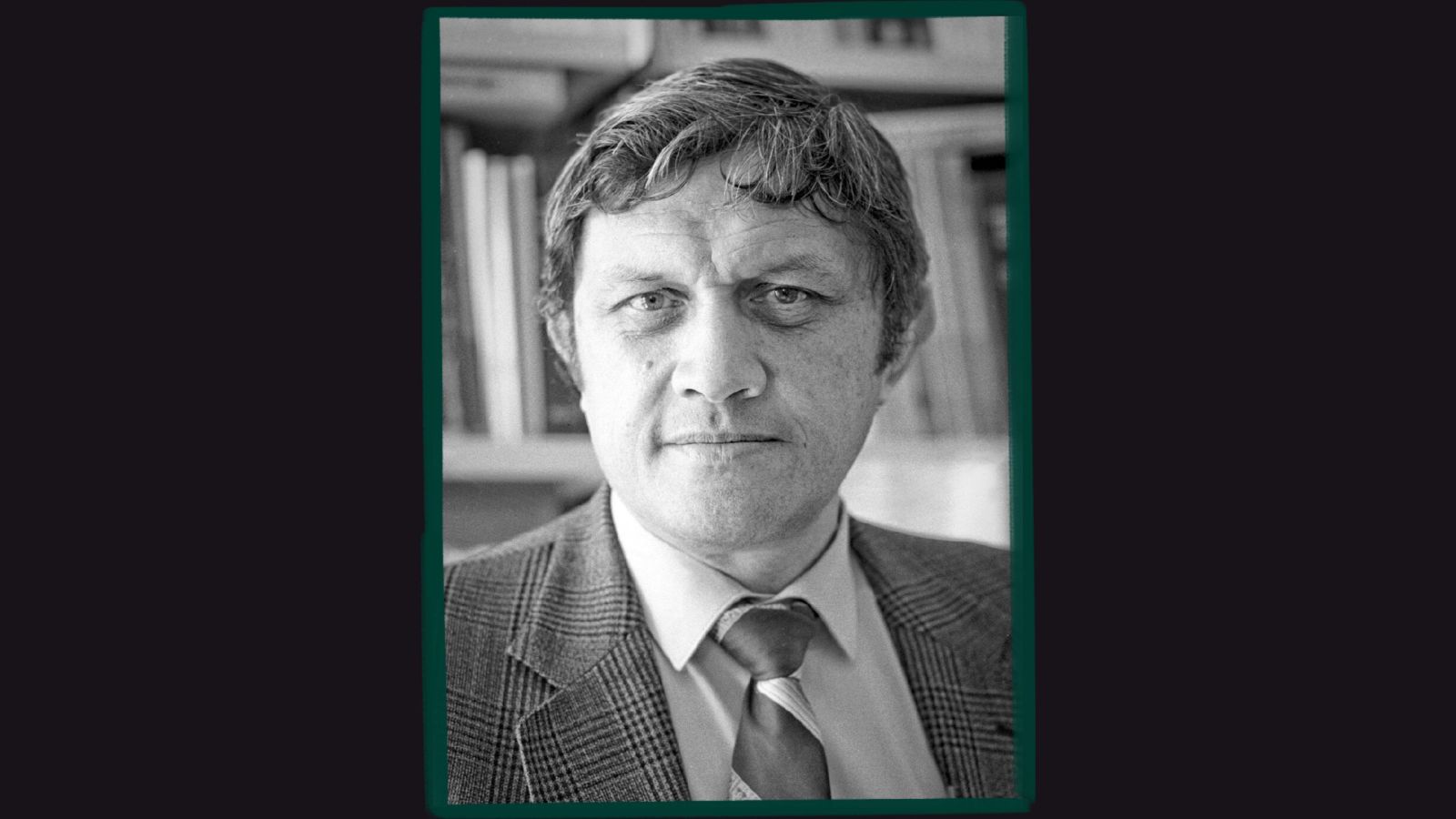
I ngā manu karapīpiti o aituā.
Kei hea rā taku mata tūhua hei haehae ake i te kiri
Hei awhi ake i te ngākau e kanetia nei.
Kua hunaia e Tāne tana manu houhare i te pō, houhare i te ao
Te manu ariki whakatakapōkai i te ahiahi
Te uri o Wahineiti i runga rā, tuku iho ki raro, ka hē o kōrero.
Takoto ki te moenga raukawakawa
Ki te moenga tē whakaarahia.
Te Herenga Waka—Victoria University of Wellington joins with whānau, hapū, iwi, colleagues, former students and communities across Aotearoa mourning the passing of Emeritus Professor Whatarangi Winiata (Ngāti Raukawa), one of the most influential Māori scholars, visionaries and educational leaders of our time.
Professor Winiata's association with Te Herenga Waka spans decades. In 1957, he became only the second Māori graduate to complete a Bachelor of Commerce degree from Victoria College of the University of New Zealand. Following postgraduate study in North America, where he earned an MBA and PhD from the University of Michigan, he became an Associate Professor of Finance and Chairman of the International Business Programme at the University of British Columbia, Vancouver. In 1975, he returned to Aotearoa New Zealand and was appointed Professor of Accountancy at Victoria University, becoming one of the first Māori professors in Aotearoa.
Emeritus Professor Tony Van Zijl summarised Whatarangiʻs time in the Faculty of Commerce: “On joining the Department of Accounting he led a number of significant change innovations including the introduction of a course on modern finance: he led a general change in the teaching of accounting to adopt a principles approach that included recognition of developments in the latest finance methodologies, a change to the structure of the Bachelor of Commerce and Administration degree to require students majoring in Accounting to complete an additional major and thus complete four years of study, and introduced the expectation of a PhD in recruitment of staff.”
In addition, Professor Winiata also served terms as Dean of the Faculty of Commerce and as Head of Department. He retired from VUW in 2002 and was awarded the status of Emeritus Professor.
Tributes from his former colleagues in the faculty include Christopher Cripps, who says, “I was a member of the school while Whata was Head of School and had the privilege of working with him closely. I always held him in the highest regard. While his intellectual leadership, vision and achievements were widely recognised, what I remember most was his compassion and kindness as well as his great sense of humour. He cared about people and treated everyone with respect and generosity. He was a person of great wisdom and integrity, but it was his humanity expressed through his kindness for others that made a lasting impression on me.
“I feel fortunate to have known and worked with him, and I know that many others will feel a great sense of loss at his passing.”
Professor Emeritus Don Trow says, “Whata was a splendid leader in the University community.”
Former student and colleague, Associate Professor Andrew Smith shared, “Whata taught me in my first year at Victoria University in 1977. He taught me again in 1979 in a finance course. He was a colleague when I joined the teaching staff in the early 1980s until he wound back his involvement with Victoria University in the late 1980s. I understand that Whata had a major role in getting the academic discipline of finance established at Victoria University (and possibly NZ). He did a PhD in Finance in Canada and brought a lot of knowledge in that area back to New Zealand. I know that being exposed to Finance in my first year of university was way ahead of what was being offered by other NZ universities at the time and I felt very privileged to be introduced to Finance at such a young age."
While his academic achievements were considerable, Deputy Vice-Chancellor Māori and Kaitiakitanga Professor Rawinia Higgins (Tūhoe) says Professor Winiata's greatest legacy lies in the transformative vision he held for the future of Māori communities.
Guided by a deep commitment to whānau, hapū and iwi development, he was the architect of Whakatupuranga Rua Mano—Generation 2000, an ambitious intergenerational strategy dedicated to the revitalisation of te reo Māori and the restoration of Māori cultural, social and economic wellbeing. This vision would ultimately give rise to Te Wānanga o Raukawa, which he helped to establish and later led as its first tumuaki. "Through these initiatives, he inspired generations of Māori learners and leaders and demonstrated the power of kaupapa Māori approaches to education and development."
Professor Peter Adds, Te Kawa a Māui says: “Professor Winiata occupies a special place in the history of Te Herenga Waka marae. Alongside the late Professor Sir Hirini Moko Mead, he successfully advocated for the establishment of our marae at Academic Board, the University Council, and with the Vice-Chancellor. He was among a generation of pioneering Māori scholars who challenged tertiary institutions to better serve Māori communities and was instrumental in establishing mātauranga Māori and tikanga in teaching, learning, and research at our university. Alongside his own scholarship, his persuasive but gentle advocacy paved the way for the record numbers of Māori students now enrolled.”
Professor Higgins says, “Professor Winiata leaves behind a legacy that extends far beyond any single institution. It lives on in the graduates he inspired, the communities strengthened through his vision, and the generations of Māori who continue to pursue excellence grounded in their own cultural values and identity.
“We acknowledge his lifetime of service and leadership. We honour his contribution to Te Herenga Waka, to Ngāti Raukawa, to te reo Māori, and to the educational and cultural life of Aotearoa New Zealand.”
Nō reira, haere e te pou o Te Tumu Herenga Waka whakangaro atu rā.