
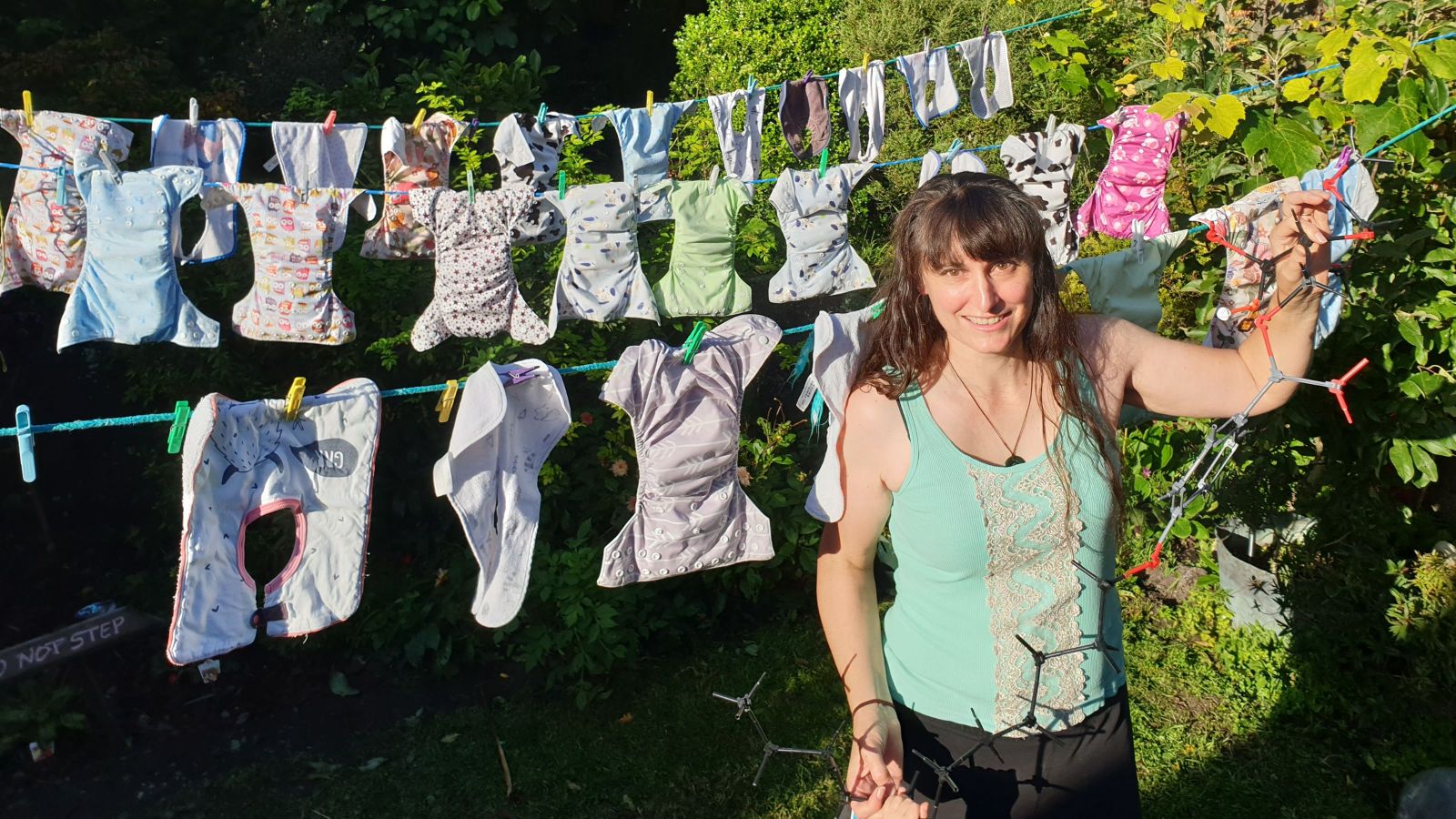
As she takes a piece of discarded paper from the recycling bin and her kids’ coloured pens, Bridget starts to draw molecules—type A, B, C, and T cells. With another colour she draws more, this time alongside receptors and a squiggly blob—the bug.
These drawings explain the core of her research at Te Herenga Waka—Victoria University of Wellington—how molecules influence the immune response.
As Bridget changes colours and turns the page to another of her eight-year-old’s pieces of art, she shares her journey from student, to academic, and her most important role—being a mother of four.
When Bridget first came to Te Herenga Waka as an undergraduate student, she enrolled in a conjoint degree covering many subjects including chemistry, technology, management, and law.
“I did lots of random things,” she says. “I found management really useful, and I really enjoyed commercial law. I also did graphics—I got a scholarship for that.”
Bridget embarked on a career in chemistry after she was presented with the VUW University of Wellington Award and Medal for Academic Excellence for being the top Bachelor of Science (Hons) graduate at the University.
She completed a PhD in Organic Chemistry under the supervision of Professor John Hoberg focusing on the total synthesis of the marine natural product, Peloruside A.
“I think what I decided was that I really liked being in a lab and having the opportunity to create something that nobody else had ever made before. And so it was that combination of being able to do something creative and feeling like there was an important goal at the end of it—I wanted to save the world.”
Bridget taught here for a short while before being awarded a post-doctoral fellowship in Switzerland. In 2006, Bridget brought her research home to Wellington, where she obtained a position at the Malaghan Institute of Medical Research and co-established the Immunoglycomics Group.
“The premise of everything that we do is looking at how molecules influence the immune response. Everything that is going on in your body is ultimately controlled by one molecule interacting with something else.
“So we focus on molecules that might interact with an immune cell. And then we look at how that immune cell affects other things and how they interact in the context of vaccination.”
Bridget says her research field is more common now, but at the time “it was quite unique to have a research group that interfaced so neatly as what we did.”
In 2011 she was awarded the New Zealand Institute of Chemistry Easterfield Medal in recognition of significant research by an emerging chemist.
She has also received several other awards and fellowships during her career, including an HRC Hercus Fellowship, and HRC Consolidator Grant, as well as several RSNZ Marsden grants and NIH funding.
In 2011, Bridget won the fiction category of the Royal Society of New Zealand Manhire Prize for Creative Science Writing. Her piece, titled Radium – a love story, was a tribute to Nobel Laureate, Marie Curie.
“When I had my fourth kid, someone jokingly told me that I’ve always been an overachiever, so I guess I find it hard to do anything by halves. I'm kind of all in or out,” says Bridget.
“If I’m all in, I have to be a little bit obsessive with it, but you can't do everything at once.
“I work really hard and I'm very focused about what I want to achieve from anything that I do, but my biggest priority is being a mum.”
Bridget’s inaugural lecture will bring together former deans from her undergraduate degree, along with her friends, her kids’ teachers and classmates, and her own children—all people who have shaped her journey to where she is now.
The main thing she wants her audience to take away from the event is “just to have learnt something new”.
“People are always interested in your background, which I'll probably touch on a little bit in the lecture, but that's not what I’m at the University for. I’m here to educate.
“I feel that the subject of chemistry can get a bit of a bad rap, so I guess my talk is aimed at providing insight in some way for everybody.”
With almost two decades of her life spent on university grounds, Bridget gestures to her surroundings and notes that “a building is just a building.”
“It’s about the people who you develop relationships with,” she says.
“An organisation is only as strong as the people in it, and there have been some really, really good people here.”
Professor Stocker’s inaugural lecture, Targeting diseases the organic way, will be held on Tuesday 7 July from 5.30–6.30 pm in the Hunter Council Chamber, Level 2, Hunter building, Kelburn campus. Register to attend.