
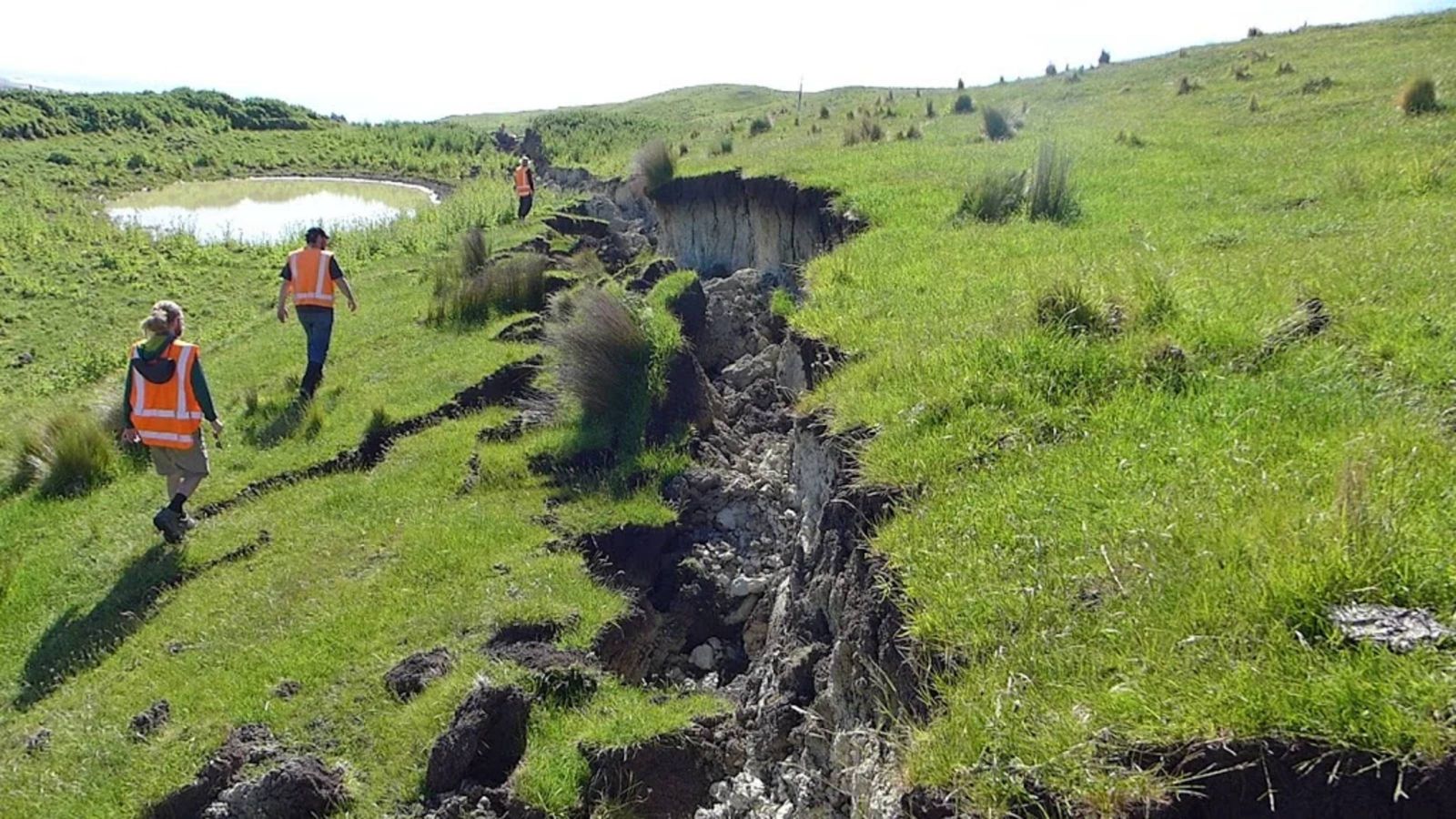
A new study of 12 major earthquakes around the globe—including two big events in Aotearoa New Zealand—provides fresh evidence to show how big quakes stop and how this can significantly affect buildings.
The study investigated large strike-slip earthquakes that move land sideways, rather than up or down. It found these quakes came to a halt abruptly, instead of slowly decelerating, and discovered a previously unrecognised “stopping phase”.
“Many of us will know a quake starts when a fault line ruptures. Perhaps less well known is that the size of a quake depends on where and when this rupture stops. In our study, we’ve identified a distinct ‘stopping phase’ that can be detected in the ground movement at the end of big quakes,” said lead author Dr Jesse Kearse, a researcher in earth sciences at Te Herenga Waka—Victoria University of Wellington.
This stopping phase is caused by a sudden jolt in the opposite direction to the movement of the fault itself—like a “whiplash” effect.
The study findings have important implications for understanding the effects of earthquakes on buildings and other large structures in urban areas.
“The sharp backwards motion of the stopping phase can be huge, up to a metre in the case of the magnitude 7.8 Kaikōura quake in 2016. These large movements that occur at the end of the fault are likely to be a generic feature of large strike-slip earthquakes and so need to be accounted for in hazard models,” said Dr Kearse.
The stopping process itself is largely hidden from view beneath the ground. But by examining seismic recordings taken from near to where these big quakes halted, the researchers were able to discover the stopping phase—essentially the sound of the quake coming to an abrupt holt.
“This distinct sound hasn’t been noticed in many past earthquakes because of the limited number of seismic recorders capturing what’s happening. Our study has been able to make use of the growing capability of modern seismic networks that record details of quake events,” said Dr Kearse.
Results of the study also indicate large strike-slip quakes occur in a “cascade”, with movement along multiple segments of the fault.
“Strike-slip fault systems, such as the Alpine Fault in the South Island, are made up of a series of discrete segments. These segments may break independently in moderate-sized events, or link together in a larger quake that extends across hundreds of kilometres.
“Whether a quake remains confined to a single fault segment or grows into a multi-segment, large magnitude event ultimately depends on whether the quake stops before spreading across segment boundaries,” he said.
Results of the study are published online in the journal Science.
The research was funded by the Japan Society for the Promotion of Science, the Earthquake Research Institute at the University of Tokyo, and an Aotearoa New Zealand Tāwhia te Mana Research Fellowship administered by the Royal Society Te Apārangi.