
Our article from May follows
Dr Pawson may have left Te Herenga Waka—Victoria University of Wellington more than 60 years ago, but the awarding of a higher doctorate to the veteran marine scientist proves he has not been forgotten by his alma mater.
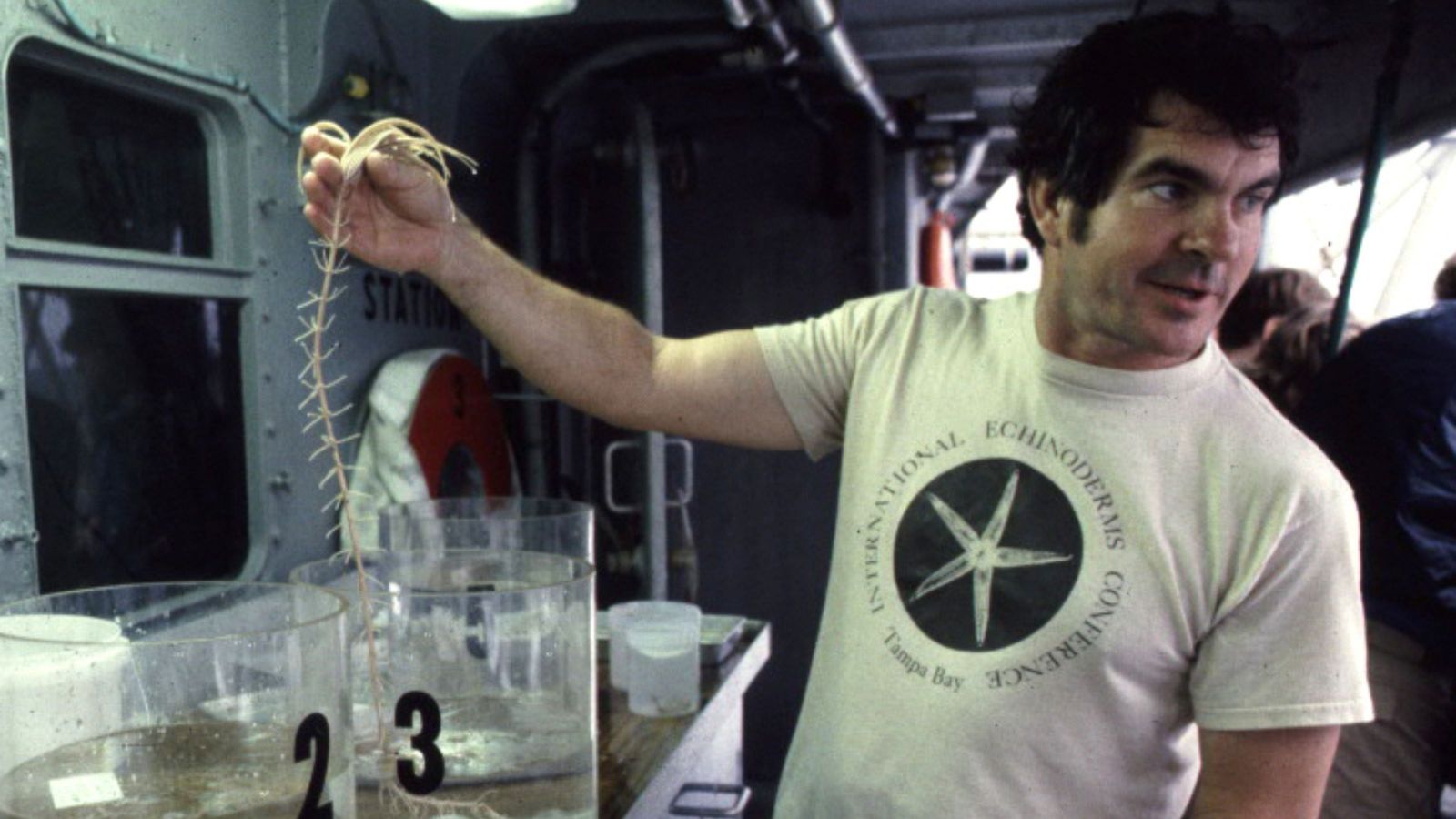
His Doctor of Science, confirmed in recognition of his excellence and leadership in his chosen field, is the latest accolade of a career spent deep sea ocean exploring, studying echinoderms and marine invertebrates such as sea cucumbers and sea urchins, to become a recognised international expert
It was an interest first spawned scrambling around the rock pools at Ahuriri‒Westshore near his boyhood home in Napier.
“So, when I went to Victoria University, further study of marine life became a ‘no brainer’, and I was encouraged by the marine interests of several faculty members and graduate students,” Dr Pawson says.
Having completed a Master of Science in 1961 and PhD at Te Herenga Waka in 1963, it then became another no-brainer to accept a position as a curator at the National Museum of Natural History in Washington DC, part of the Smithsonian, where he worked for the next 50 years.
From 1964, he studied echinoderms in many parts of the world, from Antarctica to the Galapagos Islands, using snorkel and mask, SCUBA, oceanographic ships and, mostly, little submarines, mainly Alvin and Johnson-Sea-Link, in which he has made more than 100 dives to depths in excess of two miles.
Over-fishing has been one glaring example of the changes he has seen over time—including on return trips to New Zealand witnessing the near fate of the now better managed population of orange roughy.
“Because they come in swarms in the deep-sea, they were easy to catch, and the fishery was short-lived for we tended to wipe out huge populations of these fishes with huge nets,” he says.
But much of Dr Pawson’s time has been spent studying sea cucumbers, a creature he describes as usually very fragile, noting that “when they’re preserved in alcohol, they look like ugly jello-like blobs.”
“These amazing animals flourish in the deep sea, where they may comprise more than 95 percent of the total weight of animals on the sea floor.”
From the early 1970s until recent years, Dr Pawson was a constant contributor to the International Echinoderm Conference he founded, crediting his studies at Te Herenga Waka with the skills and confidence to transform them into a life-long career.
He taught courses in his scientific specialties at Harvard University, Johns Hopkins University and George Washington University, has published more than 200 research papers and presented 200 public lectures at Smithsonian-organized lecture tours throughout the US. He also delivered the opening address at an International Deep-Sea Conference at Te Papa.
“My VUW training equipped me to conduct sophisticated research for the remainder of my career, and to rise to the highest level in my field of research, “he says.
Dr Pawson’s first wife Mary passed away in 2007; they had two children. In 2008 Dave and Doris Vance were married and co-authored more than a dozen publications about sea animals, particularly echinoderms.
In his down time studying at VUW, he pursued his insatiable love of cricket, something he was reluctant to completely let go when he became an expat.
“Literally, every day, I study the international cricket scores, and in fact, one of the things that I really missed in leaving New Zealand was cricket as I had loved playing on a VUW team.”
Now aged 87, Dr Pawson has also had to give up playing his substitute sport of golf but remains in close contact with family and friends in New Zealand, while retaining his interest in what lies beneath the ocean’s surface.
“I have been busy, and I still maintain a laboratory at ‘my’ museum, which I visit a couple of times a week.”
Dean of the Faculty of Research, Professor Neil Dodgson, oversaw the examination process, which involved two panels of examiners: three internal examiners followed by three external. He was delighted to be able to tell Dr Pawson that all six examiners agreed that he easily met the criteria for a Higher Doctorate.
"The examiners unanimoulsy agreed this would be a fitting tribute to your lifetime of achievements in the field of marine science and that your body of work was worthy of the Doctor of Sciences."