
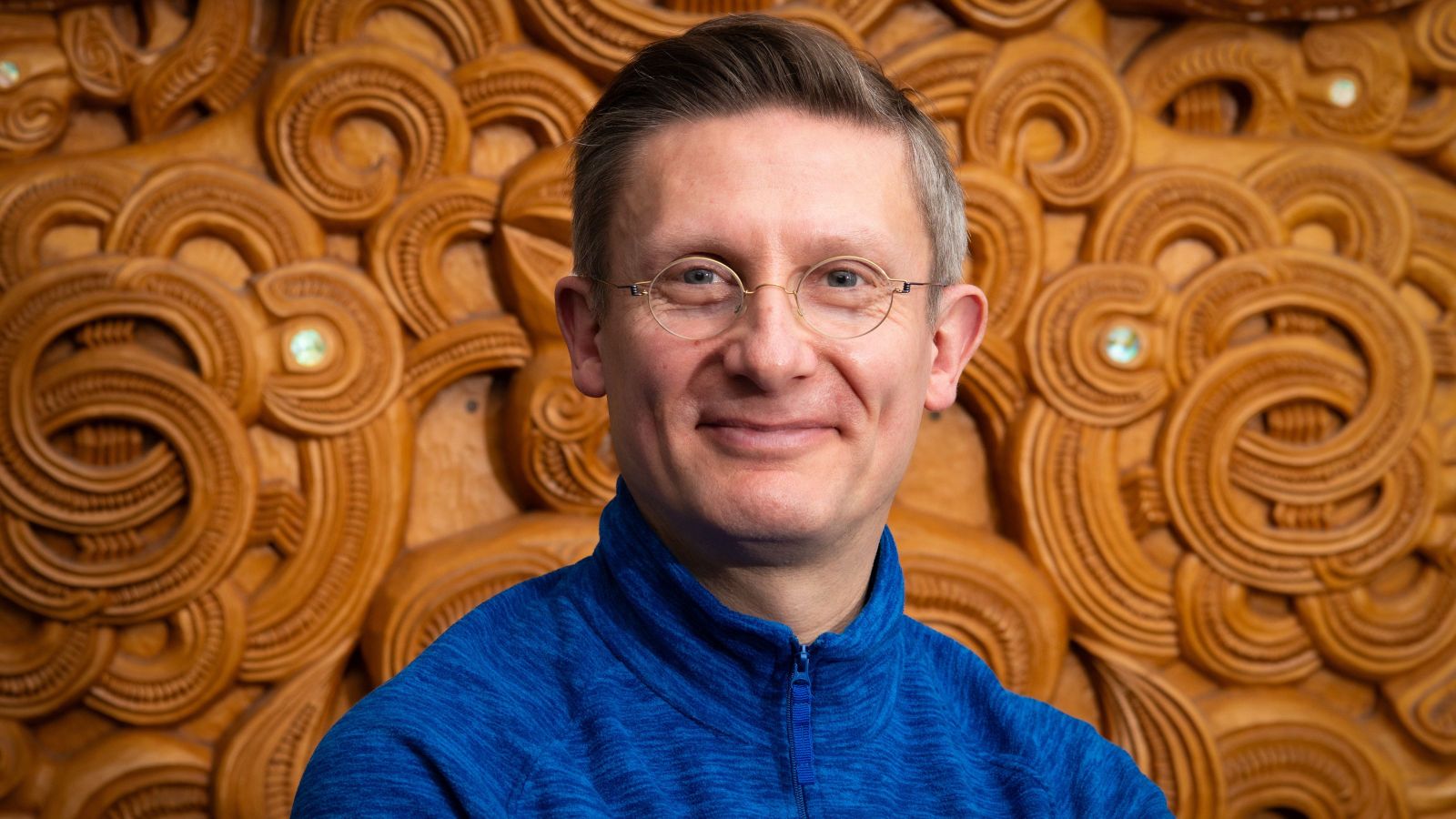
Making languages relevant has long been a challenge and crusade for Professor Marco Sonzogni from the School of Languages and Cultures at Te Herenga Waka Victoria University of Wellington.
Ahead of International Translation Day on 30 September, Professor Sonzogni says the practice of translating and interpreting languages, sometimes viewed as mysterious, is an everyday occurrence for many.
“In hospital when you are asked if you need an interpreter, it’s an understanding that your identity, your culture, and your needs are recognised. And it is a human right and a key part of everyday life.”
For Professor Sonzogni, that realisation has been lifelong, as is his honouring of the Feast Day of Bible translator St Jerome on the last day of September.
“I’ve followed it [the Feast Day] ever since I was an undergraduate student. That is the day we honour all those involved in translation.”
Earlier this month, Professor Sonzogni was a presenter at the annual New Zealand Society for Translators and Interpreters conference, which also featured many of his former students who are now researchers and practitioners in the field.
Translators put written text into documents, while interpreters respond verbally to help speakers understand in a language that may not be their native tongue. In addition, interpreters can also use sight translation, where they are given a written document and can verbally relay what it says back.
Professor Sonzogni describes translators and interpreters as “unsung heroes,” whose work deserves to be recognised for actions beyond formal straight interpretation and translation.
It’s why he and Sydney Shep from Wai-te-ata Press are involved with a cross-disciplinary project, integrating technology and languages, aimed at establishing formal protocols for translating in a crisis.
Long and short-term emergencies like the pandemic and the Auckland floods, followed hard on its heels by Cyclone Gabrielle, prompted the idea of a centralised language hub where communities including speakers of other languages could access the kinds of information invaluable in a crisis.
“Having a system to access language services, particularly in crisis translation, is something that New Zealand can have, should have, and one where Te Herenga Waka can lead those crisis conversations.”
It is an example of what he calls tangible languages, that live and breathe where many have assumed they are no longer relevant, including the use of Greek and Latin in legal and medical English.
“I grew up in an environment where languages were tangibly present,” he says of his upbringing in northern Italy where his father taught the sciences and his mother humanities.
“There’s the priest that shouts penance at you in peasant Latin, a mother who spends her teaching career poised between Greek and Latin, a father who explains everything with chemistry and a brother who is already a computer wizard, and also in the way music or art or mathematics can be regarded as their own kind of languages too.”
Professor Sonzogni took up a role with Te Herenga Waka in 2005 after many years working in translation in Italy as well as Ireland.
His talents proved invaluable for Italian media covering the Irish Peace Process, and among other assignments he worked alongside the Red Cross in Kosovo, fuelling his belief any crisis needed to have a plan for providing translation support in place.
“Language has put me at the heart of things happening, so when you witness some of these things, you must learn from them.”
Since 2019, Professor Marco Sonzogni has worked with graduates from his Master of Intercultural Communication and Applied Translation, offering them the opportunity to participate in Work Integrated Learning, a tertiary level work experience type programme, which helps graduate students interact with professionals in the public sector —including a language service programme with the Ministry of Business Innovation and Employment, which has now trained more than 400 translators and interpreters.
It is yet another example of the tangible means by which translating and interpreting contributes to everyday life, he says.
“The challenge is to integrate the languages of cultural communication further into the sciences, as they are changing the way we operate.”
He says translation and interpretation continue to make their presence and relevance felt in more expected but powerful ways too.
“When Trump and Putin met in Alaska, who were the only two other people in the room? Their interpreters.”
International Translation Day is on Tuesday 30 September, coinciding with the Feast Day of Bible translator St Jerome, the patron saint of translators. Find out more at United Nations: International Translation Day 30 September