
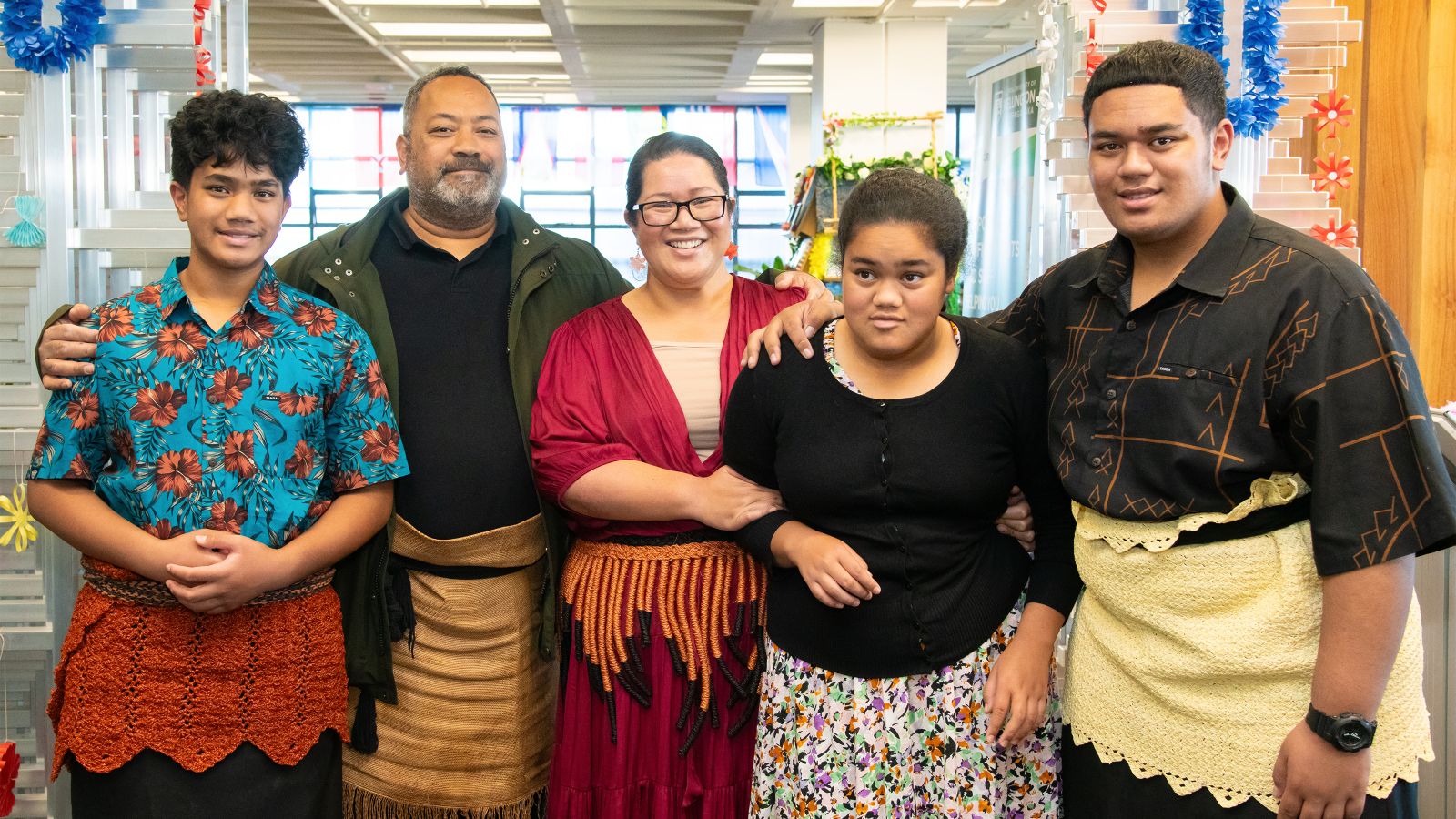
After working as a social worker for children and young people in Auckland, Melemo moved to Wellington with her family to get into policy work, initially in an attempt to circumvent the need to go back to university.
“Then I realised there were gaps in my understanding of some of the foundational frameworks, paradigms and theories, systems and processes, things that I needed to learn in order to progress,” Melemo says on her decision to return to study. “But also, as a Pasifika woman, doing my Master’s gave me the confidence to contribute in meaningful ways in a more senior role.”
Melemo has three children—the youngest of whom is “the boss of the family,” she says. “Because she’s autistic and very connected to me, I didn’t realise at the time, but I didn’t really leave home much. Studying forced me to leave home, and I appreciated that because it also gave me downtime from the heavy lifting that you do at home in terms of carrying a child with special needs. Not so much physical, it’s the mental load that you need space from.”
There have been benefits for everyone in her family, Melemo says, like encouraging her sons to be more independent and pitch in to help with things like cooking dinner. “For them to see my struggle and sacrifice, they learn what it means to struggle for something that you really want.
“Now I tell them, ‘when you get a Master’s, then you can challenge me. We can’t have a conversation if your evidence is social media or you’re not connecting it to real life. That’s not a debate.’ Now they know they have to bring evidence. Often with island boys, they can be shy to speak up at school, given that our culture is so respectful of authority. Now they know how to be more vocal.”
It was important to Melemo that her family didn’t become a reason that she didn’t take opportunities. Working full-time while she studied part-time was a challenge, but she wanted to give it a go. “I didn’t know if I was going to be successful and make it all the way to the end, but I was going to try my best,” she says. She graduates with her Master of Public Policy (MPP) from Te Herenga Waka—Victoria University of Wellington at the Pasifika graduation celebration this May.
Melemo, who is Tongan, now works as a Principal Advisor Women’s Strategy at the Department of Corrections—a role that helps drive gender responsive approaches that reflect the lived realities for women and builds directly on what she learned during her Master of Public Policy. Her studies have equipped her to use research and data to inform strategy, build her understanding of how systems work and boosted her confidence to lead work that deals with complex policy challenges. Melemo began her studies while working at New Zealand Police, where she received support that has continued through into her current role at Corrections.
Studying at the Wellington School of Business and Government was an obvious choice for Melemo, as she lives in Wellington, but she had also heard “really good things” about the MPP and valued the opportunity to connect with different people. She was able to tailor her degree for her needs and interests and appreciates that the structure meant she was able to choose what she wanted to learn.
The lecturers were a huge part of her success, Melemo says. “I asked for so many extensions, but their flexibility and humanising approach meant that I felt like they still kept my mana. They saw the whole of me, being a busy parent, not just the student part of me. Their generosity and willingness to support me helped me navigate the often-stressful time of studying and deadlines.”
Melemo’s advice, especially for Pasifika students, is to “lean into your village”. “Often Pasifika can get intimidated about asking for help, but you don’t have to do it alone. During my undergrad degree or when I was studying social work, I never spoke to any of my lecturers or tutors, but I very much leaned into that this time around, and I’m so grateful that I did.”
She encourages Pasifika students to ask for help, and also to use their unique perspective and voice, because sometimes it helps others learn in different ways too.
One of Melemo’s favourite courses was An Introduction to Quantitative Analysis for Public Policy, because she “didn’t do great” with maths in high school and had been intimidated by it since then.
“What that paper showed me is that with hard work—and lecturers who obviously care about their topic and understand it so well that they can simplify it for others who don’t work with data and maths all the time—I can do whatever I put my mind to. I can now read the data and understand them. It gave me confidence and I know if I back myself and if I put in the effort, then nothing is impossible for me. It was a real mind shift for me.
“I say that to a lot of women now, because women are the centre of their families, and when women do well, families and communities do well.”