
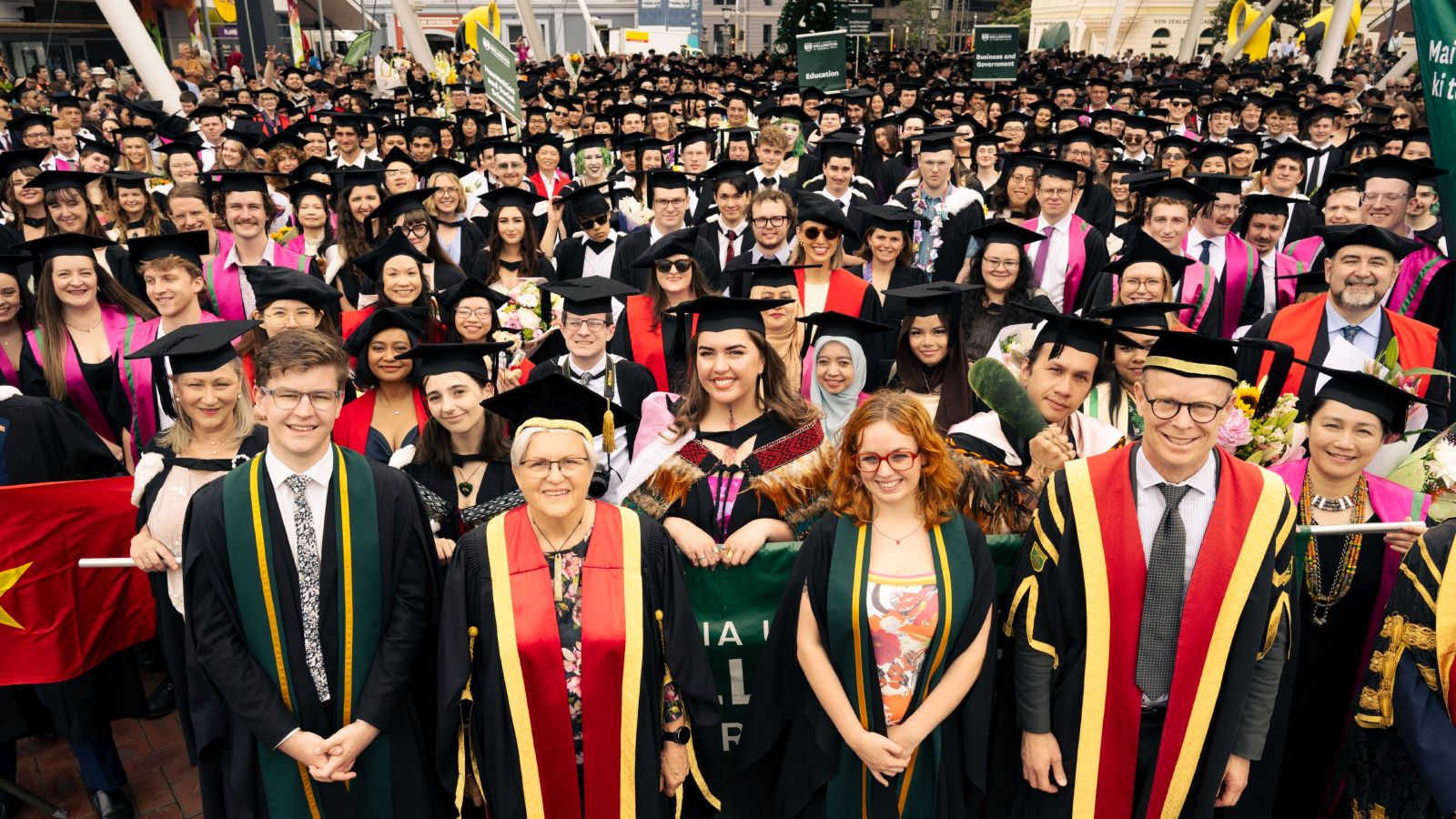
Awarded to the top 5 percent of doctoral candidates, the Dean’s List is a formal record and public acknowledgement of work judged by examiners to be of exceptional quality, which makes an outstanding contribution to a graduate’s particular field of research.
The awardees and summaries of their research are listed below:
Amy Cruickshank—School of Accounting and Commercial Law
Amy’s thesis, Government financial support for the charitable sector in New Zealand, explores how government funding influences the charitable sector in New Zealand, raising important public policy considerations. Her research focuses on three key areas: the institutional landscape of charitable giving, including trends in donations, donor characteristics and charity income; the effect of donation tax credits on taxpayer behaviour and whether such incentives are an effective mechanism for government support; the role of government grants in shaping charity revenues—specifically whether they complement or crowd out other sources of income.
Drawing on comprehensive population-level data and modern causal inference methods, Amy’s work provides fresh insights into how public funding shapes charitable giving in New Zealand.
Amy will graduate in December.
Ross Taylor—Robinson Research Institute
Ross’s research focuses on an innovative type of electromagnet that uses special superconducting materials to save energy compared to traditional designs. He developed a better way to measure key properties, making it easier to create accurate models. His work also compares different magnet designs—some using copper, others using superconductors—to see which performs best. His research helps advance compact, powerful magnet systems, and provides useful information for future technology.
Ross will graduate in December.
Nicholas Protsack—New Zealand School of Music
Nicholas’s thesis, An entangled language of music and nature—exploring musical ecopoiesis, examines his concept of musical ecopoiesis—a creative process in music and sonic art that is directly influenced by the natural world. He argues that nature itself plays a role in shaping many aspects of musical practice and culture, acting as an active contributor rather than a passive backdrop or loose inspiration. While this practice has appeared across countless cultures and historical periods, there is a lack of comprehensive research frameworks to analyse its fundamental mechanisms. Nick’s work introduces a practice-centric framework aimed at providing a deeper understanding of both the past and future of musical ecopoiesis, offering new perspectives on how sound can invoke and interact with the environment.
Nick will graduate in December.
Christian Raymond—School of Engineering and Computer Science
Christian’s research explores how artificially intelligent systems can autonomously learn their own goals and learning objectives. His work demonstrates that deep neural networks can meta-learn by leveraging past experiences, allowing them to independently guide their own training process without human intervention.
Christian will graduate on Wednesday afternoon at the Engineering and Science graduation ceremony.
Jessica Wilson—International Institute of Modern Letters
Jessica’s PhD is in creative writing, which means that her thesis has two components—a creative part and an academic interpretation. Jessica walked Te Araroa, Aotearoa's 3000km national tramping track, and wrote about it. Her hybrid memoir interweaves the story of her hike with interviews of other walkers, analysis of social-science research on long trails, close readings of other trail memoirs, and thumbnail histories of the land. She investigates how meaning gets made on long walks, what happens when heroic-journey narratives break down, and how long trails may help unify indigenous and settler peoples, visitors, and locals.
Jessica graduated at the Faculty of Humanities and Social Science graduation ceremony.
Professor Neil Dodgson, Dean of the Faculty of Graduate Research, says each recognised thesis had to be of exceptional quality in every aspect, from originality and significance of the scholarship to quality of expression and overall presentation, and time taken to complete the work.
“In the last five months we have examined over 70 doctorates. Ten of those were shortlisted, from which five were selected to go on today’s Dean’s List. Every thesis that passes is, of course, a success and an enormous achievement for the graduate, but every thesis on the shortlist is exceptional in some way.”
Professor Dodgson said the inclusion of two creative theses on the Dean’s List, in creative writing and music respectively, was particularly significant.
“This highlights the excellence of our creative departments and the importance that this university puts on high-quality research in the humanities.”