
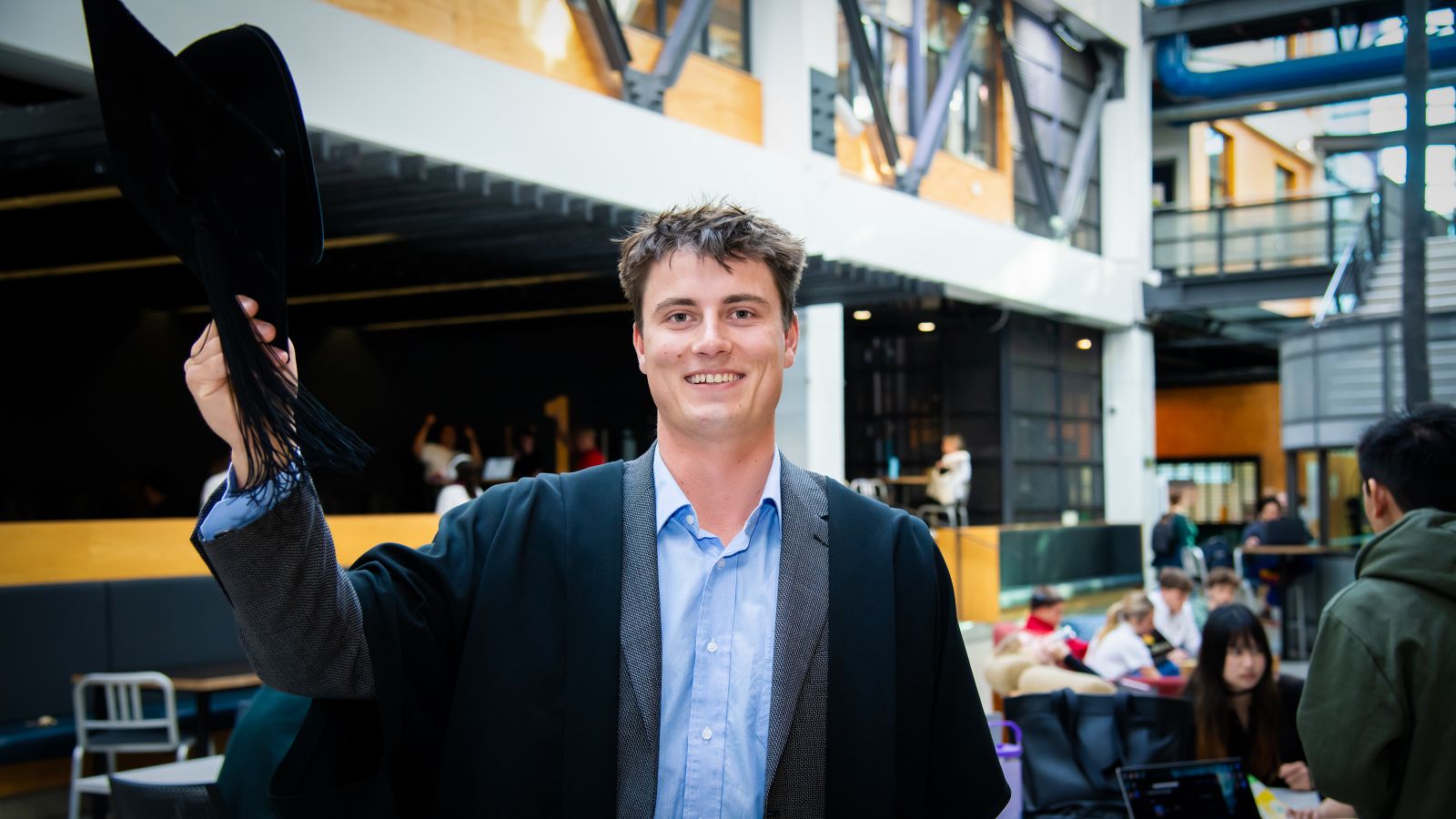
Henry (Ngāti Raukawa, Ngāti Toa) will graduate from Te Herenga Waka—Victoria University of Wellington this week with a Bachelor of Building Science in Sustainable Engineering Systems and Project Management. His career path began by chance, when a friend’s dad offered him work as a labourer on his construction site during the school holidays. Henry realised he enjoyed the work more than he expected, and set about pursuing a tertiary degree where he could deepen his knowledge.
The Building Science degree proved the perfect fit, and his chosen path was further solidified when he was named as the inaugural recipient of the Keystone Trust The Building Intelligence Group (TBIG) School Leaver Scholarship. TBIG has been a sponsor of the Trust for 10 years.
Keystone Trust is a charitable trust established 30 years ago that supports tertiary students across Aotearoa New Zealand who are seeking to study for a career in the property and construction sectors. Keystone Trust scholarship recipients receive financial support, but it’s the broader support that’s the most meaningful, Henry says.
“Keystone Trust support is about so much more than the money—it’s about the mentoring, the networks you get access to, the work experience. It’s your gateway into the construction industry.
“Keystone Trust is run off people's generosity and time—some 68 industry sponsorships and donations. Everyone there, from the sponsors to the Trust team, just has a genuine interest in helping you and getting the best out of you.”
As part of his scholarship, Henry was mentored by TBIG project manager Darcy Palmer and says the industry insight this relationship offered was incredibly valuable. Darcy was working on Ngā Mokopuna at the time, which aspires to meet the standards of the Living Building Challenge® (LBC), the most ambitious and rigorous building standard in the world.
The mentorship meant Henry was offered an inside look at the challenges involved in managing a project of this scale and complexity, and how these were overcome in a way that maintained Ngā Mokopuna’s status as one of the world’s most environmentally responsible buildings.
Henry says the sense of community he found on campus was crucial to his success. He was part of a solid group of friends who met in their first year of the Building Science degree, and who supported each other through the challenges that come with assignment deadlines and long hours of study.
The key part of developing these friendships, he says, was making a commitment to attend class in-person, rather than watching lectures online.
“I definitely want to emphasise the importance of showing up and being present. There was a group of us who just turned up every day and treated it like a nine to five. Having those friendships, having that consistency and those people you can go to for help, made it that much more enjoyable.
“That’s a skill that carries over to construction as well—a lot of the time it’s more worthwhile to be present and go on-site rather than sending an email. It helps build those trusting relationships, which is going to make the whole process smoother.”
He says that beyond the support of his community, one of the key factors to his success was putting himself out there whenever he was given the opportunity.
“There were so many networking events, whether set up by Vic or by Keystone. They can be daunting, but everyone is always so willing to talk to you, and you’ll get so much value out of those chats.
“Construction is quite a small community—everyone sort of knows everyone. So if you have a chat to someone they might be able to connect you to someone else down the line. It’s also a great way to learn about the different avenues a degree like that can take you down.”
Henry completed a summer internship at TBIG during his studies and has now landed a job there as an Assistant Project Manager. He says the best part of his work is the variety and the opportunity to problem-solve on a range of projects.
“I’ve got a wide range of projects I’m involved with at the moment, and they’re all at different phases, so it’s very interesting to get to be a part of those. That’s the good thing about project management—there’s always going to be something different every day.”
Ultimately, Henry says he’d do it all again.
“Studying for my degree was definitely up there with some of the best times of my life, for sure. I always say to my mates, I’d probably do the three years all over again—turning up and being with them every day was good fun.”