
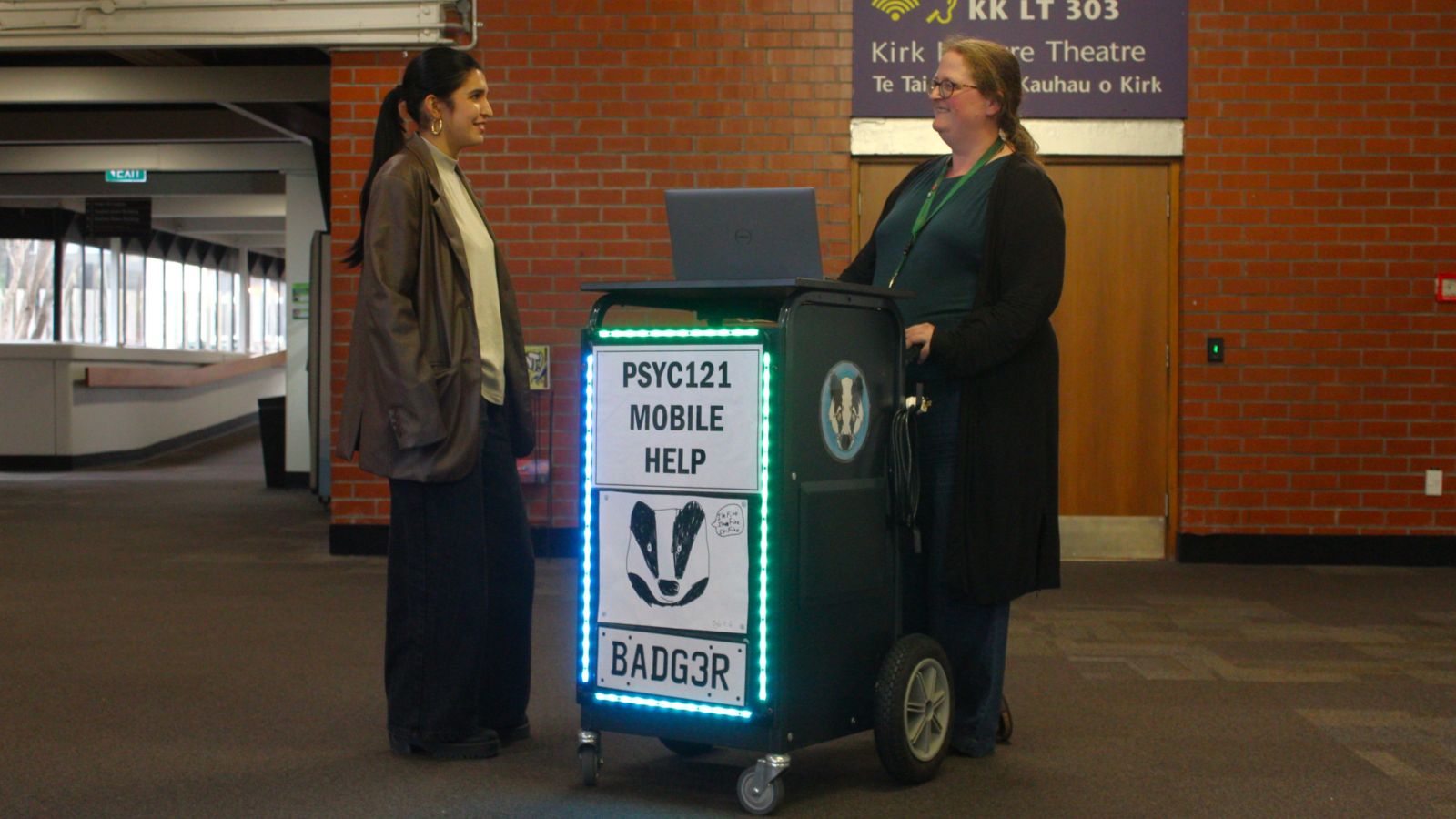
A more visible and approachable alternative to traditional office hours, the Badger Cart, named after a Psychology 121 teaching activity, has quickly become a popular resource for first-year psychology students.
After a successful debut last year, the cart has become a permanent fixture, providing support to students before and after classes. Stationed outside lecture theatres in the Kirk building, the cart is manned by School of Psychology staff ready to answer any course-related questions.
In response to a noticeable decline in office hour attendance and a desire to encourage greater on-campus engagement, the initiative sought to make course support more visible and accessible to students.
“We’d already tried all sorts of approaches; including offering an online office hour, but students just weren’t showing up,” explains Dr Tash Buist, a senior lecturer and course coordinator.
“Some of my colleagues started staying around after lectures to answer students’ questions, and they found that was more effective than the traditional office hours.”
While popular, first-year psychology papers can still feel isolating, especially for students who aren’t sure where to turn for support or don’t feel comfortable speaking up in class.
The Badger Cart, easily identified by its colourful lights and fun art, has become a straightforward and effective cue for students seeking help, offering a friendly and approachable presence.
“We often forget that even something as simple as walking down the corridor to knock on a door can feel dauting for students. By stepping out and being more accessible, we aim to make that process easier for them.”
The initiative has proven successful, with a noticeable increase in engagement.
“Even students who don’t need help will come and chat with us, which is great. It’s just a casual drop-in that requires no effort, and the visibility of the Badger Cart reassures them that help is available when they need it.”
One of the more amusing moments in the project’s early days was just how quickly it all came together. The idea had only just been mentioned when, later that same day, Roger Ward, the University’s learning space designer, rolled the cart into Dr Buist’s office.
Dr Buist took inspiration from Principal Lamb, who gained attention online for trading his office for a mobile desk to better connect with staff and students. When the idea was shared with Roger, a collaboration quickly took shape.
“Sue, my colleague, mentioned that Tash was looking for a mobile lectern, and I remembered some old carts we had lying around that were no longer in use,” recalls Roger, who brought the idea to life. “It was great to see how Tash was able to repurpose those materials to extend this service and improve student engagement.”
Since its launch, Roger has made a series of practical upgrades to the cart, adding everything from a cup holder to speakers.
“It’s all much less intimidating, and a bit fun for us too,” says Dr Buist. “At first, my colleagues weren’t so sure. They’d say, ‘Really? You want me to do what?’ But once they saw how students responded, they got on board. They’ve been supportive.”
In a world increasingly shaped by online tools and digital spaces, it’s easy to overlook the power of simple, student-centred approaches. Yet, as Dr Buist and her colleagues have found, sometimes all it takes is a friendly face, a touch of creativity, and maybe a few LED lights, to build meaningful connections.