
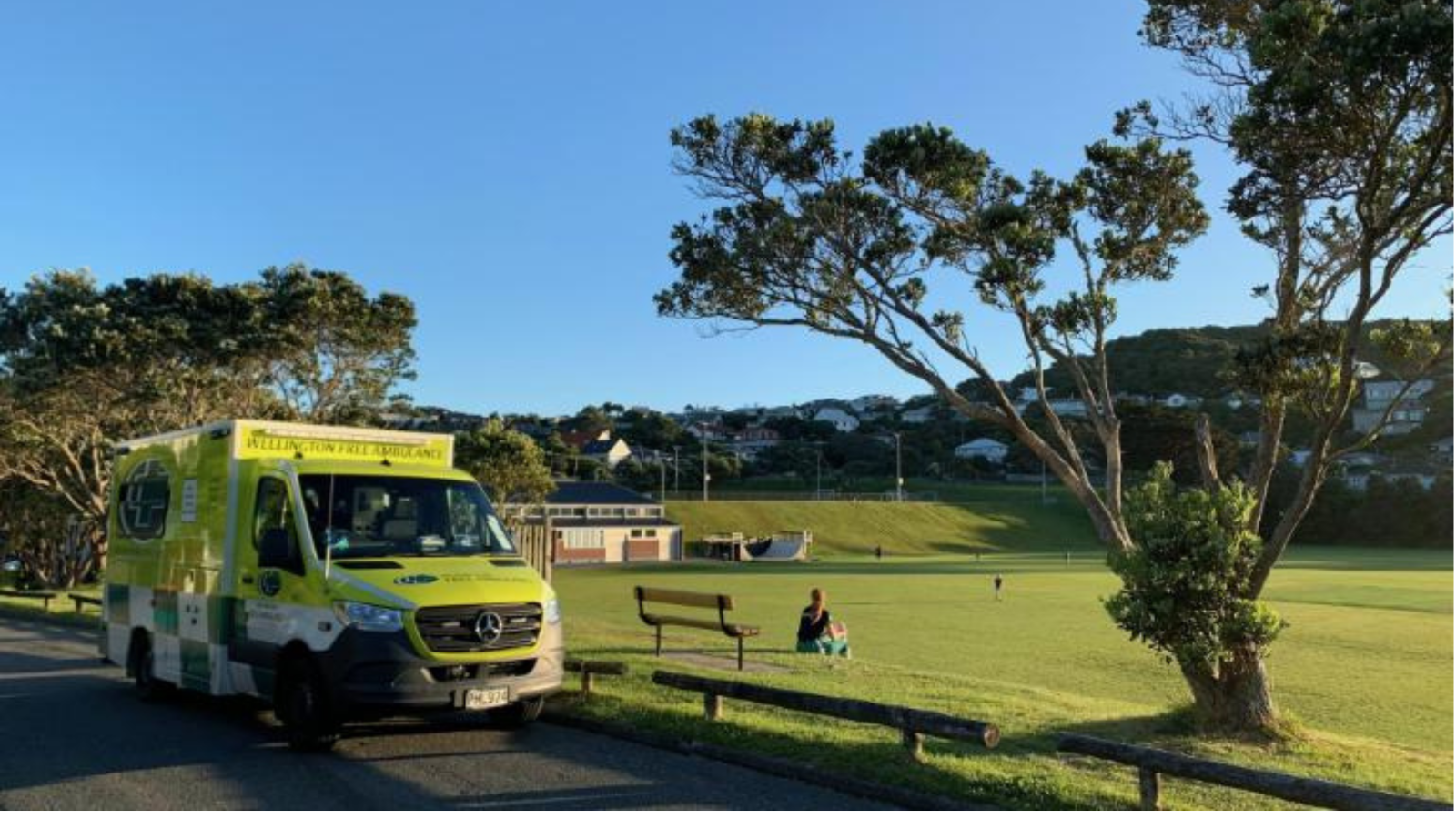
So, when selecting a topic for my PhD at Te Herenga Waka - Victoria University of Wellington, I looked for how my background in machine learning could give back to the ambulance sector. My sister, a paramedic with Wellington Free Ambulance, suggested I look at how emergency dispatch worked: at the decisions that lead to a specific crew knocking on your door.
What I set out to do was simple enough: get the right crew, with the right equipment, to the right patient faster, without burning through paramedics to do it.
Turns out it’s one of the hardest real-time optimisation problems there is.
Hato Hone St John and Wellington Free Ambulance crews attended more than 640,000 incidents in the 12 months to July 2026, up more than 12% on the 12 months to July 2022. Dispatchers, the people co-ordinating our nation’s emergency fleets, sit in a room that most of us will never see, doing a job most of us couldn’t. They decide which ambulance goes where, who holds back, who covers a gap, who stops for lunch, and who goes home on time.
Dispatchers have to make decisions before facts arrive. Nobody knows when the next emergency will occur or where it will be, how serious a patient will prove, how long a crew will need with the patient, or whether they need to go to hospital. Every decision they make impacts every decision going forward. It is not a failure of training, effort, or resourcing, but a problem that demands a decision when it’s impossible to know which is optimal. Dispatchers are trained to handle this uncertainty while ensuring response times are minimal and paramedics get a chance to breathe between jobs.
Paramedicine, like all medical professions, is powered by people. Unfortunately, that means that paramedics are just as human as the rest of us. Every time a meal break is interrupted, a shift runs over, or an ambulance is redirected to a more urgent job, there is a small personal cost. One that accumulates over a career to result in the average Wellington paramedic lasting only seven years on the road, following an international trend. This means that roughly 28% of paramedics are still working a decade after registration, compared to around 73% of doctors.
Our research team, led by my supervisor Professor Yi Mei and funded by an MBIE Smart Ideas grant, has spent the past five years trying to help. What we are building sits alongside the systems dispatchers already use, recommending what to do next in real time, responding to new emergencies and crew updates as they occur.
In a fraction of a second, our machine learning model can present recommendations to dispatchers that they can accept, change, or ignore. Every time we’re given the same situation, we return the same recommendations, so every decision can be audited after the fact. While we can’t see the future, we can simulate millions of emergencies to learn which dispatch decisions can be made differently to reliably improve response times.
In late 2024, Health New Zealand asked us to validate our technology via a third party called Omda, a publicly traded Norwegian company. Omda simulated one year of de-identified historic Wellington Free Ambulance data, using the same emergencies, in the same place, at the same time. The difference was that our model decided who should go where and when. Compared to a benchmark co-designed with Wellington Free Ambulance to reflect the decisions of dispatchers, our model improved the average and 90th percentile response times across all urgency categories. This result was enough for Health New Zealand, ACC, and Wellington Free Ambulance to support further evaluation of the technology via a phased real-world trial.
We are partnering with Omda to build an integration with Wellington Free Ambulance that will enable a six-month passive parallel run on data de-identified in real time, starting in mid-2027. This will allow us to compare every dispatcher decision against what our model would have done on messy, real-world data without the risk of affecting dispatcher decisions. If this parallel run is successful, we will work with our partners to implement the technology safely in New Zealand, and then to ambulance services further afield.
Inspired by a sound my family and I are all too familiar with, we have started a company called Weewoo. There are currently six of us in the team, all motivated by the impact seconds can have.
Most people won’t notice when we go live. Paramedics will drive less and get lunch more often. Ambulances will arrive sooner, and more patients will pull through. One day, that could mean my sister reaches you in time.
This comment was originally published in the Sunday Star Times. Supervisors are: Professor Yi Mei, Dr Fangfang Zhang, and Professor Mengjie Zhang.