
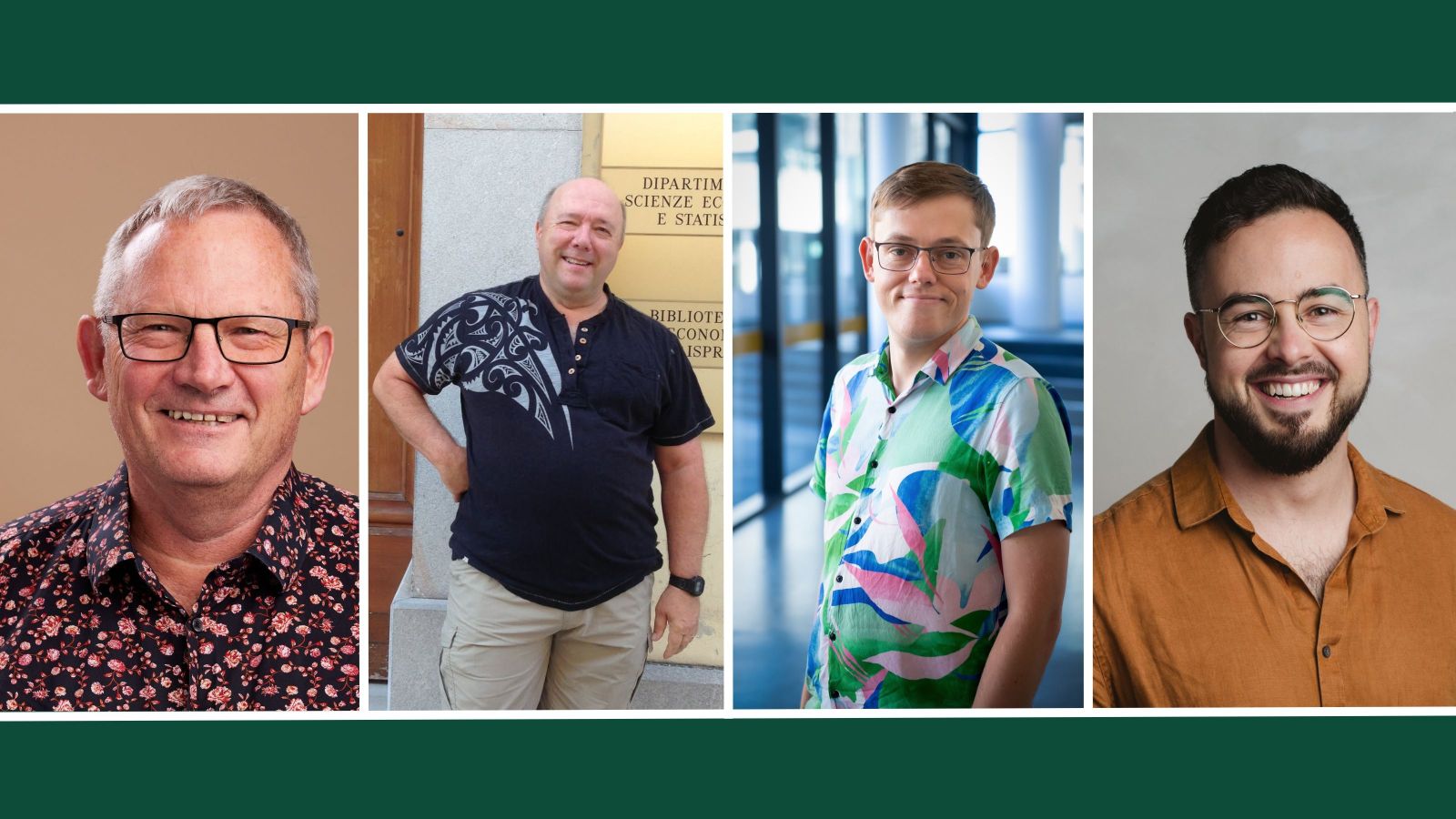
Professor James Renwick, Emeritus Professor Rod Downey, Dr Andrew Lensen, and Dr Kris Nielsen have been recognised for their contributions across a range of fields.
Professor James Renwick has received the 2026 Callaghan Medal, awarded for an outstanding contribution to science communication, for his commitment towards generating more awareness about climate science. This also recognises his work contributing to international climate reports, informing policy, engaging the public, and translating science into action for Aotearoa New Zealand.
The Jones Medal for lifetime achievement in pure or applied mathematics or statistics was presented to Emeritus Professor Rodney Downey for his work on looking at how the algorithmic content of mathematics can be applied to processes.
Dr Andrew Lensen is the recipient of the 2026 Cooper Award, the Early Career Research Excellence Award for Technology, Applied Sciences and Engineering, for proposing a new mathematically interpretable method using AI to simplify complex datasets while preserving structure. This approach is a step towards trustworthy and accountable real-world decision-making.
Dr Kris Nielsen has received the 2026 Early Career Research Excellence Award for Social Sciencefor his work on the development of 3e Psychopathology, an innovative theoretical framework that reimagines the normative basis and explanation of mental disorders.
Deputy Vice-Chancellor (Research) Professor Sally McArthur says “Congratulations to all the recipients—this is a truly remarkable achievement. Creating real-world impact through research is one of the fundamental pillars of the work that we undertake at Te Herenga Waka.
“University research has a key role to play in influencing and leading the creation of evidence-backed policy, especially in times like this when the entire research system across Aotearoa is going through significant change. It is clear that our staff’s research has tremendous value, both within New Zealand and overseas, and it’s a great honour for their work to be recognised as part of these prestigious awards.”
About the 2026 recipients
Professor James Renwick
Professor Renwick is one of Aotearoa New Zealand’s most influential climate science communicators, with over three decades of sustained public engagement. He has delivered numerous talks and policy briefings to communities, industry, and government, translating complex climate science into accessible and trusted information, and advised agencies on climate monitoring and risk. His leadership roles on Intergovernmental Panel on Climate Change (IPCC) reports and national advisory bodies demonstrate that his science informs public discourse and decision-making. The recipient of the Prime Minister’s Science Communication Prize and other national honours previously, his work has informed public understanding and helped shape national conversations about climate change, its risks, and the value of science in addressing them.
Emeritus Professor Rod Downey
Emeritus Professor Downey’s research has always been concerned with understanding and applying the algorithmic content of mathematics. What processes can be done algorithmically, and if they can, how fast can they be done? Can we develop general methods to analyse such questions? Can we apply answers to design new algorithmic methods from problems in practice? Can we use computational methods to understand and apply randomness? Given the ubiquitous roles of mathematics and computing in modern life, scientific advances rely on deep mathematical as well as technological advances. Developing tools for this enterprise is of central importance.
Dr Andrew Lensen
Dr Lensen’s research has played a significant role in exploring how explainable AI can be leveraged more reliably in real-life decision-making processes. His work has focused on addressing one of the key limitations in the field of nonlinear dimensionality reduction (NLDR)—it’s over-reliance on opaque, “black box” optimisation processes. Dr Lensen has developed GP-MaL-LT, a novel implicit mapping framework that uses genetic programming to evolve human-interpretable functional transformations. With a carefully designed fitness function that ensure that essential relationships within the data are not compromised, this approach represents a conceptual and technical advance over others. Beyond academia, Dr Lensen has emerged as a public voice on AI ethics and governance in Aotearoa New Zealand.
Dr Kris Nielsen
Are mental health conditions brain dysfunctions, understandable reactions, or something else entirely? On what basis can we say something is wrong when someone is depressed? Answers to such questions inform everyday decisions in healthcare, research, and policy. Dr Nielsen’s proposed framework, 3e Psychopathology, views mental disorders through the lens of enactivism, a naturalistic yet non-reductive perspective on human functioning. His framework proposes that mental disorders can be seen as maladaptive patterns in sense‑making, unfolding within the intertwined system of our brain, body, and environment. Dr Nielsen is currently working on an international research collaboration, which aims to build on the proposed and related approaches, working towards a new way of understanding, researching, and treating mental health problems.