
Roosevelt Island Climate Evolution project
The RICE Project aims to improve understanding of the stability of the Ross Ice Shelf and West Antarctic Ice Sheet in a warming world.
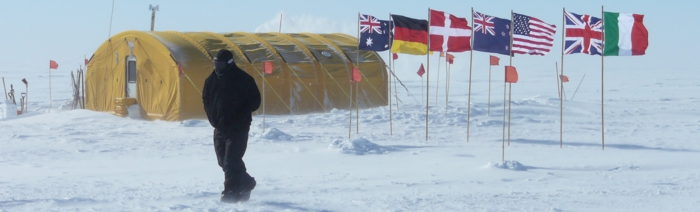
RICE is a New Zealand-led international collaboration with partners from Australia, Denmark, Germany, Italy, People’s Republic of China, Sweden, U.K., and U.S.A.
During the 2011/12 and 2012/13 Antarctic field seasons, they recovered a 764 m deep ice core to bedrock. The aim of the project is to improve our understanding of the stability of the Ross Ice Shelf and West Antarctic Ice Sheet in a warming world.
Nestled within the heart of the Ross Ice Shelf in Antarctica, Roosevelt Island serves as a sentinel for understanding the past and future of Earth's climate. The Roosevelt Island Climate Evolution (RICE) project is a multinational scientific endeavor aimed at unlocking the secrets held within the island’s deep ice layers. By drilling a 763-meter ice core, researchers have gained access to a climate archive stretching back over 80,000 years, with older ice yet to be dated.
The central goal of RICE is to assess the stability of the West Antarctic Ice Sheet (WAIS) and the Ross Ice Shelf in the face of a warming climate. These ice masses are critical to global sea level, and their potential collapse could have profound consequences for coastal communities worldwide. Through detailed analysis of the ice core, scientists are reconstructing past climate conditions, including the last glacial period and the transition into the current interglacial era.
A key focus of the project is the Last Interglacial period, which occurred around 129,000 to 116,000 years ago. During this time, global temperatures were similar to or slightly warmer than today, and sea levels were several meters higher. Understanding how the Antarctic ice sheets responded during this warm interval is crucial for predicting their behavior under current and future climate scenarios. The RICE core provides valuable data on ice sheet dynamics during this period, helping scientists identify thresholds that may trigger rapid ice loss and sea level rise.
This record provides a rare window into how the Antarctic climate system responded to natural warming events. By studying these ancient shifts, the RICE team is identifying the thresholds and feedbacks that govern ice sheet retreat, offering vital clues for predicting future changes.
Beyond historical reconstruction, RICE is also refining climate and ice sheet models, improving our ability to forecast Antarctica’s response to rising greenhouse emissions and associated warming. The insights gained are not only advancing scientific understanding but also informing global strategies for climate resilience.
In essence, RICE is a bridge between past and future—using the frozen memory of Roosevelt Island to illuminate the path ahead in a rapidly changing world.
Visit the RICE website